
Catfish Sinkers: Shape, Weight, and Why Yours Keeps Moving
Your sinker’s job isn’t being heavy — it’s staying put. Shape does more of that than weight, and almost everyone reaches for the wrong one.

Your sinker’s job isn’t being heavy — it’s staying put. Shape does more of that than weight, and almost everyone reaches for the wrong one.

There is no such thing as “the catfish regulations.” There are fifty sets, revised every year, with an exceptions list under each one.
Color won’t tell you. Size definitely won’t. The anal fin will — and in some states, getting it wrong is a citation rather than an embarrassment.

Channel catfish move over a hundred miles a year. Which means when you’re not catching them, the problem usually isn’t your bait — it’s that the fish weren’t there.
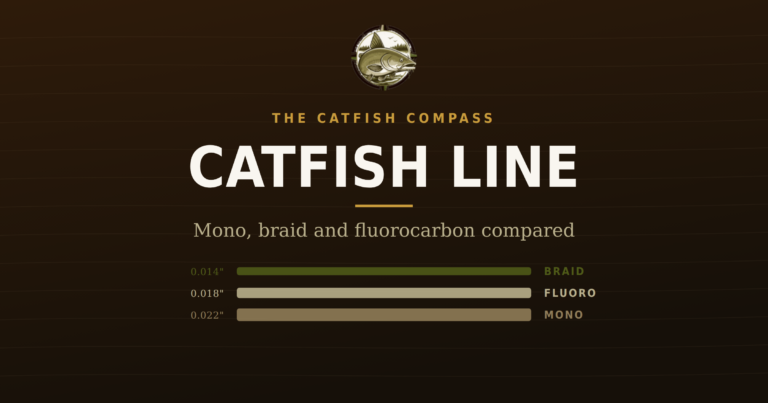
Fluorocarbon is sold on invisibility. A catfish isn’t looking at your line. Here’s what actually decides the choice — and the stretch number everyone repeats that turns out to be wrong.

The circle hooks in your box may not be doing what you think. Offset versus inline, which type suits which bait, and why hook size follows the bait and not the fish.
A catfish is close to a swimming tongue — 175,000 taste buds, most of them nowhere near its mouth. What that means for the bait you tie on.
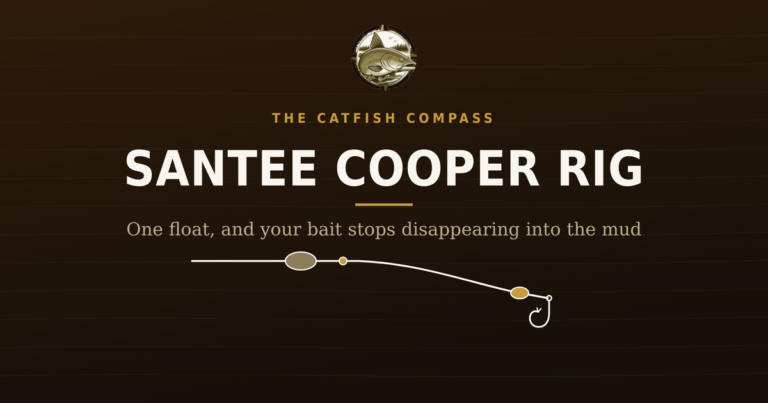
A slip sinker rig plus one float. What that float does, how to size it to your bait, and the conditions where you should leave it in the box.

The spec most people get wrong is action. Why a fast rod fights your circle hooks, and how to pick power, length and material without overspending.
Five catfish rigs, five presentations. Which one to tie on, how to tie it, and why the slip sinker rig is the foundation the other four build from.