Catfish Line: Mono vs Braid vs Fluorocarbon
This post contains affiliate links. If you buy through them I earn a small commission at no extra cost to you. As an Amazon Associate, I earn from qualifying purchases.
Fluorocarbon is sold on one idea: that it vanishes underwater. The physics behind that is real, and it is a great deal smaller than the marketing.
Light bends when it passes between materials of different optical density, and the measure of that is refractive index. Fresh water sits at about 1.33. Fluorocarbon is about 1.42. Nylon monofilament is about 1.52.
So fluorocarbon does sit closer to water than mono does. It does not sit on water. A gap of 0.09 is not zero, and only zero would be invisible. A round line also behaves like a cylindrical lens, gathering light and focusing it into a bright thread along its length no matter how well the index matches — which is why fluorocarbon lifted off the bottom can glow brighter than mono rather than dimmer.
But there’s a bigger problem with the whole argument, and almost nobody selling line will say it out loud.
A catfish is not looking at your line.
A catfish finds food by following a chemical trail with taste buds spread across its entire body — what catfish actually eat covers how that works. It feeds on the bottom, in stained water, often at night. The visibility argument that drives most fishing line marketing was written for bass anglers sight-fishing clear water in daylight. For what you’re doing, it’s close to irrelevant.
Which is liberating, because it means you get to choose line on the three things that actually decide the outcome: abrasion resistance, diameter, and where the stretch goes.
The short answer
If you don’t want the rest:
Mono in 20–30 lb is the right answer for most catfishing, most of the time. It’s cheap, it’s forgiving, it handles abrasion well, and its stretch works in your favour with a circle hook.
Go to braid when you’re fishing heavy current, deep water, or hard structure — 50–65 lb, which is thinner than the 20 lb mono you’d otherwise be using. Add a mono or fluorocarbon leader when you do.
Fluorocarbon belongs on the leader, not the spool. Buy it for abrasion resistance and sink rate, not for invisibility.
Skip the rest if that’s all you needed. What follows is why.
What actually decides it
Abrasion. Here’s what doesn’t make it onto the packaging: most line you lose, you lose to something sharp on the bottom — not to a fish that was too strong. From the bank especially, because everything you hook has to come back across whatever is between you and it, and you can’t reposition to change the angle. It’s the property that matters most and gets talked about least.
Diameter. Current pushes on line. The thicker the line, the more it pushes, the more your rig lifts and drags downstream, and the more weight you need to hold bottom. Diameter is why braid changes what’s possible in a river. The other half of holding bottom is the sinker itself.
Stretch. It matters, but not in the direction most people think, and not by nearly as much. More on that below, because the number everyone repeats is wrong.
Notice that visibility isn’t on the list.
The three materials
Monofilament
A single extruded nylon strand. Cheap, widely available, easy to tie, and forgiving of the mistakes everyone makes.
What it does well: it stretches, which cushions a lunging fish and — importantly — lets a circle hook rotate into the jaw corner instead of being ripped through it. It resists abrasion well. It floats, or near enough. It’s cheap enough to respool without thinking about it, which matters more than it sounds.
What it does badly: it’s thick for its strength, it absorbs water, and it degrades in sunlight. A spool of mono has a usable life of roughly two to three years; leave it on a reel in a truck bed through two summers and it will fail on a fish.
Use it: as your main line for most bottom fishing in lakes and moderate current. 20–30 lb covers the great majority of channel and blue cat fishing.
Braid
Multiple fibres woven together. Almost no stretch, and dramatically thinner for the same strength.
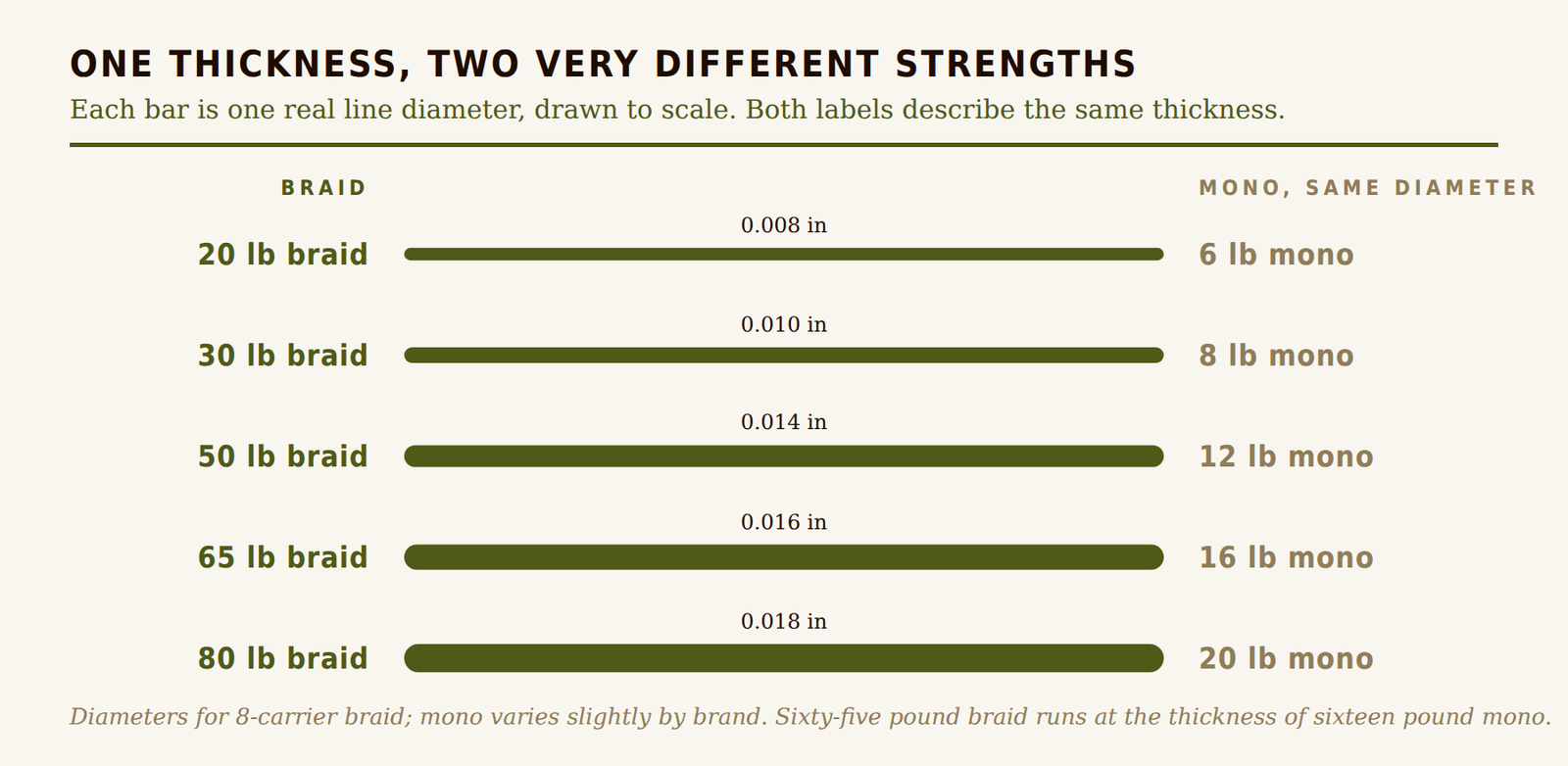
The diameter difference is the whole point. Measured on 8-carrier braid:
| Braid test | Diameter | Same diameter as |
|---|---|---|
| 20 lb | .008 in | 6 lb mono |
| 30 lb | .010 in | 8 lb mono |
| 50 lb | .014 in | 12 lb mono |
| 65 lb | .016 in | 16 lb mono |
| 80 lb | .018 in | 20 lb mono |
Read that again, because it’s the argument. You can fish 65 lb braid at the diameter of 16 lb mono. In current, that’s not a small improvement — it’s a different kind of fishing. Less bow in the line, less weight needed to hold bottom, better contact with the rig.
What it does badly: it has no stretch to cushion anything, it’s expensive, it’s visible (which we’ve established doesn’t much matter), and it cuts into itself on the spool if you set the drag hard on a poorly packed reel. It also has no give at all against a sharp rock — it’s strong in tension and unimpressive against an edge.
Use it: rivers, heavy current, deep water, snaggy structure. 50–65 lb. Always with a leader.
Fluorocarbon
Denser than water, so it sinks. More abrasion resistant than mono. Less stretch than mono, more than braid. Expensive, and stiffer to tie.
The honest position: fluorocarbon’s marketed advantage — invisibility — is the one that matters least to a catfish. Its real advantages are abrasion resistance and sink rate, and both of those are leader properties, not main line properties. It also lasts: a five to eight year shelf life against mono’s two to three, because it doesn’t absorb water.
Use it: as a leader, in 30–50 lb, where the line is going to be dragged across whatever is down there. Not on the spool, where you’d be paying four times the price of mono for a benefit you can’t use.
The stretch number everyone repeats is wrong
You will read everywhere that monofilament stretches about 25%. It’s in every comparison article and most product copy.
Someone actually measured it. Testing mono and braid on light and heavy setups with drags set to a realistic one-third of the line’s breaking strength, the measured stretch was:
| Setup | At 50 ft | At 100 ft |
|---|---|---|
| Light mono | 2% | 2.5% |
| Light braid | 0.7% | 0.8% |
| Heavy mono | 7% | 8.75% |
| Heavy braid | 1% | 0.8% |
The conclusion was blunt: with a properly set drag, fishing normally, you will never encounter the 25% figure at all. To get there you’d have to load the line near its breaking point, which a correctly set drag exists specifically to prevent.
What survives is the ratio, not the number. Mono stretched two to ten times more than braid depending on the setup. That difference is real and worth choosing around — you just shouldn’t imagine you’re fishing a rubber band.
And for catfish there’s a wrinkle that runs opposite to how bass anglers think about this. Stretch is usually framed as bad, because it costs you hooksetting power. But you don’t set a circle hook — you tighten down and let the rod load while the hook rotates into the jaw corner. A little stretch helps that happen and makes it harder to snatch the hook out early. Catfish hooks covers the mechanism.
If you fish circle hooks on mono, the stretch is on your side.
Diameter and current
Here’s what thin line buys you in moving water.
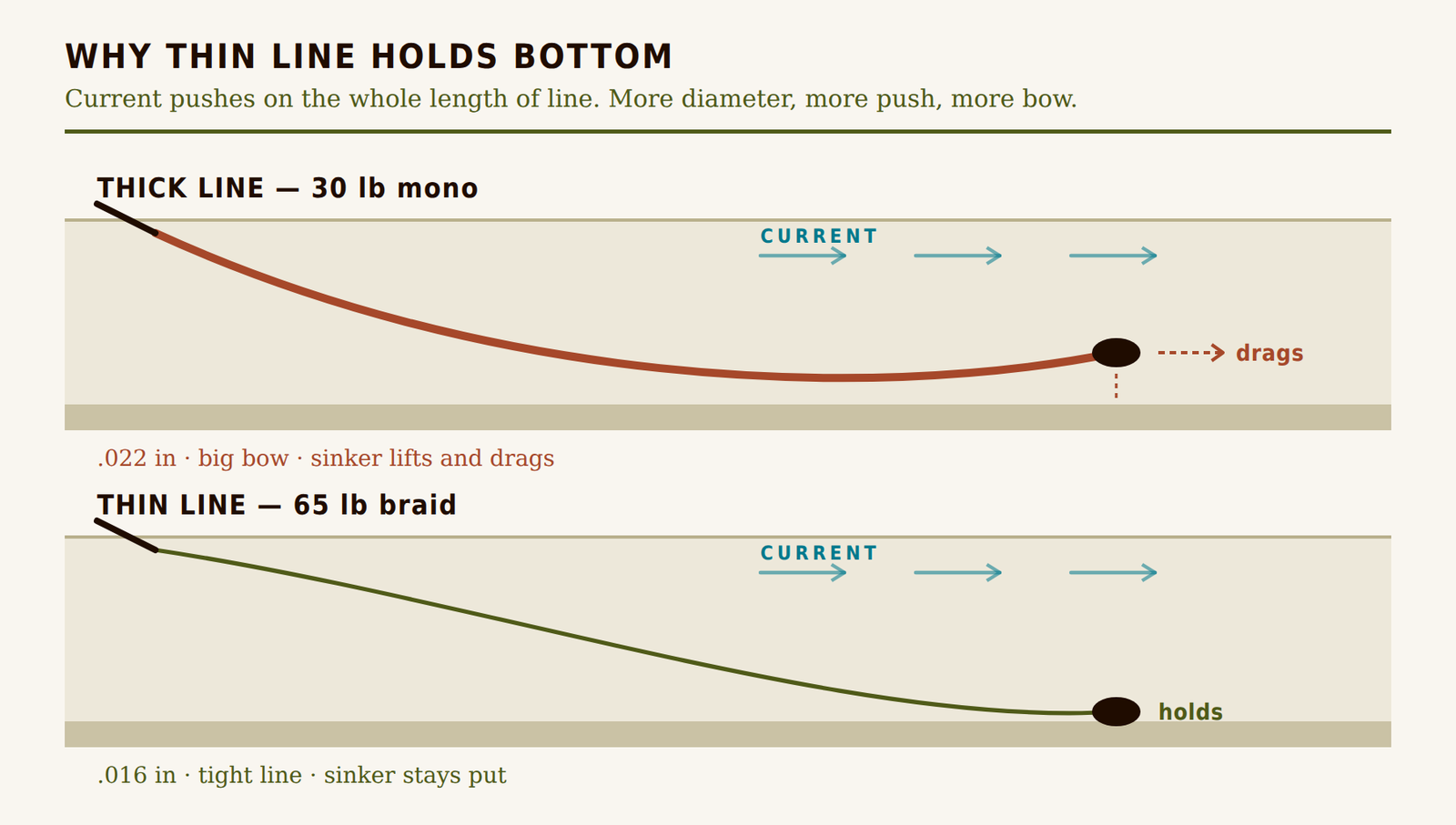
Current pushes against the whole length of line between your rod tip and your sinker. That push bows the line downstream, and the bow does two things: it lifts your sinker off the bottom, and it puts a curve between you and the bite so that a fish can move several inches before you feel anything.
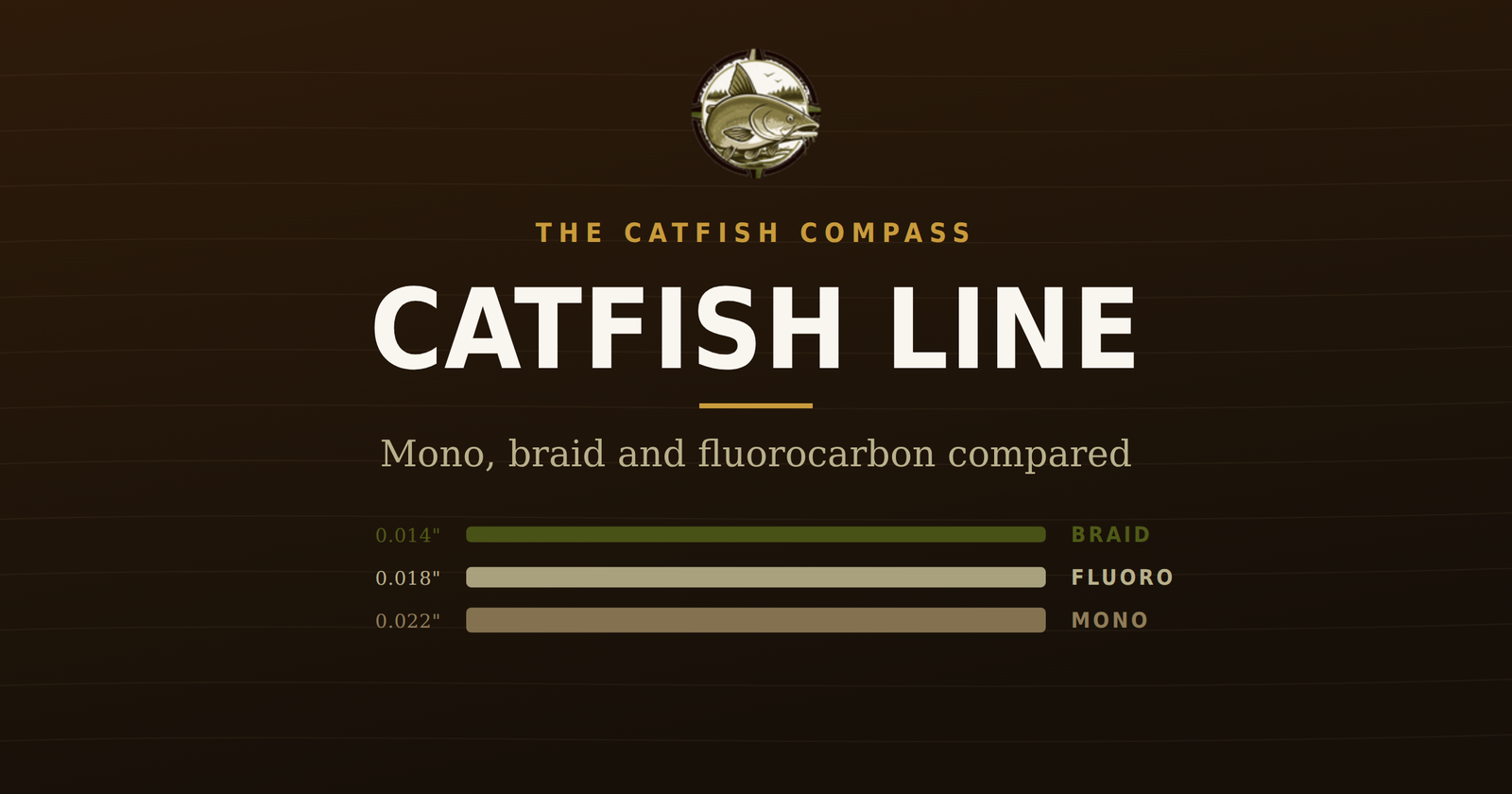
Thicker line catches more water and bows more. Which means holding bottom in current is not only about adding weight — it’s also about reducing the line’s surface area. Going from 20 lb mono at roughly .018 in to 50 lb braid at .014 in cuts the line’s profile substantially while nearly tripling the breaking strength.
The practical result is that you hold bottom with less lead, your rig sits where you put it, and you feel the bite when it happens rather than a moment later. In still water none of this matters much and mono is the better buy. The faster the water, the more the argument swings to braid.
Main line and leader
The mistake is treating this as a single choice. Most well-built catfish rigs use two different lines because the two ends of the rig have different jobs.
The main line covers distance and fights current. You want strength, manageable diameter, and enough abrasion resistance to survive the trip.
The leader is the eighteen to thirty-six inches that will actually be dragged across rock, shell and timber, and that a fish will be sitting on top of. You want abrasion resistance above everything.
That’s why braid main line plus a mono or fluorocarbon leader is such a common setup — braid for the thin diameter through the water column, a stretchier and tougher material at the business end where it gets abused.
And here’s the rule that makes it work, which a lot of guides get backwards.
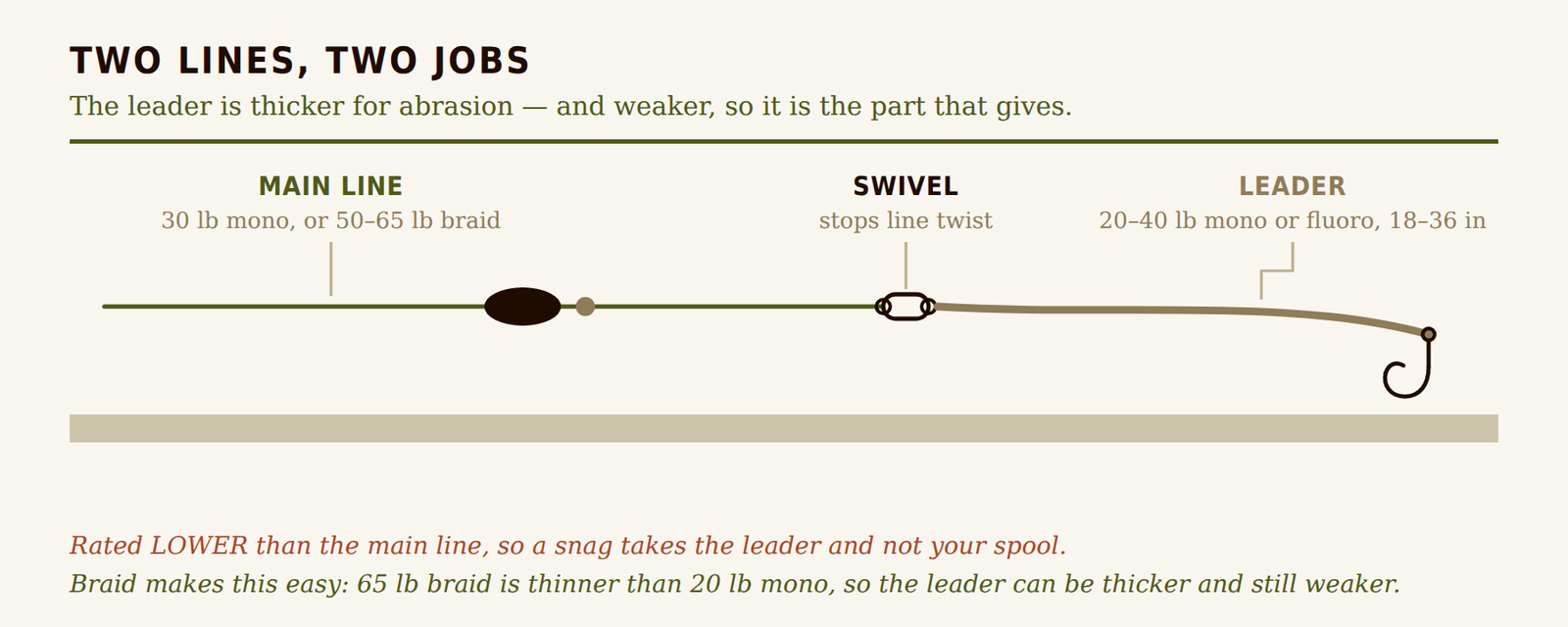
The leader should be thicker than the main line, and rated lower. Thicker because diameter is what survives abrasion. Rated lower because when you snag — and on a catfish bottom you will — you want the leader to be the part that gives. If the leader is stronger than the main line, the main line breaks instead, and you don’t lose a hook and a sinker, you lose thirty yards off your spool and every knot you tied.
Braid is what makes both things possible at once. Sixty-five pound braid runs at .016 in; twenty pound mono runs at .018 in. So a 30 lb mono leader on 65 lb braid is simultaneously thicker than the main line and less than half its breaking strength. Thick where it’s dragged, weak where it needs to fail.
With mono main line you can’t have both, which is the honest limitation: a mono leader thick enough to resist abrasion is usually also strong enough that your main line breaks first. Keep the leader at or below the main line’s rating and accept slightly less abrasion resistance, or move to braid.
A practical structure that works for most catfishing:
- Main line: 30 lb mono, or 50–65 lb braid in current
- Leader: 20–40 lb mono or fluorocarbon, 18–36 in — always rated below the main line
- Connection: a barrel swivel, which also stops line twist
The exception is a three-way rig, where the sinker hangs off a short dropper of lighter line. There, the dropper is the fuse by design — it breaks and you lose a sinker while keeping the hook, the leader and the fish. That frees you to run a heavy leader, because the weak point has been deliberately moved somewhere cheaper. Something in the rig has to be the weakest link; the whole skill is choosing which.
The complete guide to catfish rigs shows where the leader sits in each of the five presentations.
Pound test by situation
| Where you’re fishing | Main line | Leader | What gives first |
|---|---|---|---|
| Ponds, small lakes, channel cats | 20 lb mono | 15–20 lb mono | leader |
| Lakes, mixed size, some structure | 30 lb mono | 20–25 lb mono | leader |
| Rivers, moderate current | 50 lb braid | 30–40 lb mono or fluoro | leader |
| Heavy current, deep, snaggy | 65 lb braid | 40–50 lb fluoro | leader |
| Trophy flatheads in timber | 80 lb braid | 60–80 lb mono | the dropper, on a three-way |
Read down the last column, because it’s the part that matters. In every row something is designed to break before your main line does, and you decide what. For four of these it’s the leader. For the flathead row the leader is heavy on purpose and the fuse has been moved to a lighter sinker dropper — which is the whole logic of the three-way rig.
Also worth noticing: the jump from mono to braid happens where current and structure — not fish size — start dictating what’s possible.
Hook size, incidentally, is not about line strength either. A 3/0 to 5/0 will land the largest channel cat or blue you’re likely to meet on any of these lines.
When to change your line
Mono is cheap and this is where people are strangely frugal. Twelve dollars a year is not the hill to die on, and I’d rather re-spool a reel I didn’t need to than lose the best fish of the season to line I was nursing through a second summer.
Replace mono annually if you fish regularly, and sooner if the reel has lived in sunlight. Nylon absorbs water and degrades with UV, and the failure isn’t gradual in a way you’ll notice — it’s fine until a good fish, and then it isn’t.
Run the last twenty feet through your fingers before you start. Roughness, nicks or a chalky feel mean cut it back. That’s the section that’s been dragged across everything.
Braid lasts far longer — up to a decade in storage — but it fades and can fray at the guides. It also doesn’t tell you it’s damaged the way mono does. Reversing the spool to put the unused end into service is a cheap way to double its life.
Fluorocarbon leader material keeps for years, which is the one place its five-to-eight-year shelf life genuinely pays you back.
Mistakes that cost fish
Buying fluorocarbon main line for invisibility. Covered at the top. You’re paying a premium for the one property that doesn’t apply to the fish you’re chasing.
Fishing braid with no leader. No stretch, no abrasion tolerance, straight to a sharp rock. A leader is the cheap part of the rig and it’s meant to be sacrificial.
Tying a leader stronger than your main line. A very common one, and it quietly defeats the point of having a leader at all. On a snag the main line breaks instead and you lose everything above the break.
Over-spooling with heavy mono. Thirty pound mono is thick. Fill a reel with it in current and you’ll spend the day adding lead to fight your own line.
Setting the hook out of habit on a stretchy line. Mono plus a circle hook is a good combination precisely because you don’t swing. Swinging pulls the hook out before it can rotate.
Leaving three-year-old mono on a reel. The cheapest component in the system and the one people won’t spend twelve dollars replacing.
Frequently Asked Questions
What pound test line is best for catfish? 20–30 lb mono covers most channel and blue catfishing. Move to 50–65 lb braid for heavy current, deep water or hard structure. Trophy flatheads in timber justify 65–80 lb.
Is braid or mono better for catfish? Mono for most situations — it’s cheaper, more abrasion tolerant, and its stretch helps a circle hook set. Braid wins in current and around structure because it’s far thinner for the same strength, which means less line bow and better bottom contact.
Do I need fluorocarbon for catfish? Not as main line. Catfish hunt by smell rather than sight, so the invisibility you’re paying for doesn’t earn its keep. Fluorocarbon is worth using as a leader, where its abrasion resistance and sink rate do matter.
Does line colour matter for catfish? Very little. Catfish feed by scent in stained water and often at night. High-visibility line that you can see is arguably more useful than line the fish can’t, because watching the line is how you detect a lot of bites.
How often should I change catfish line? Mono once a year with regular use, sooner if it’s been stored in sunlight. Braid lasts several years but should be reversed or replaced when it frays. Check the last twenty feet by feel every trip.
What leader length should I use? 18–24 inches for most bottom rigs, 24–36 inches when you want the bait to move more or sit higher. The Santee Cooper rig uses the longer end of that range for a reason.
Should my leader be heavier or lighter than my main line? Thicker, but rated lower. Diameter is what resists abrasion; a lower breaking strength is what makes the leader — rather than your main line — the part that snaps on a snag. Braid main line makes both possible at once, because it’s far thinner than mono of the same rating. The exception is a three-way rig, where a lighter sinker dropper is the deliberate weak point and the leader can be heavy.
Can I use braid as a leader? It’s a poor leader. Braid has no abrasion tolerance against an edge and no stretch to cushion a surge. The leader’s whole job is to survive contact with the bottom, which is exactly what braid is worst at.
Where to go from here
Line is the one component that touches every other part of the system, and it’s the one most people choose by reading a package. Get the material matched to the water and the pound test matched to the structure, and everything else in the rig gets easier.
Once the line is sorted, the next decisions are what you tie to it — catfish hooks covers type and sizing, and the complete guide to catfish rigs covers the five presentations they go on. If your rod is fighting you on the hookset, choosing a catfish rod explains why tip action and line choice interact.
Reviewed September 2026.
Sources
- Refractive index values for water, fluorocarbon and nylon monofilament — Master Fishing Magazine, “Why Fluorocarbon Isn’t Invisible: The Optics Explained”; corroborated by GF Reports, “Fluorocarbon vs Monofilament Fishing Line”
- Measured line stretch under realistic drag settings — FishTalk Magazine, “Fishing Line Stretch Test: Stretching the Truth”
- Braid diameter and mono-equivalent chart (8-carrier braid) — The Tackle Room, “Braided Fishing Line Guide”
- Line shelf life by material — GF Reports, as above