How to Rig for Catfish: 5 Rigs That Cover Almost Every Situation
This post contains affiliate links. If you buy through them I earn a small commission at no extra cost to you. As an Amazon Associate, I earn from qualifying purchases.
New to this? Start here — the beginner’s guide covers where to fish before you worry about which rig.
Most catfishing advice starts with bait. That’s backwards. You can put the best cut shad in the lake on a hook, and if it’s pinned flat to a muddy bottom in three feet of current when it should be riding twelve inches above it, you’ll sit there all evening wondering where the fish went.
Rigging is about presentation — where your bait sits in the water column, how it behaves in current, and whether a fish can pick it up without feeling anything wrong. Get that right and mediocre bait catches fish. Get it wrong and good bait doesn’t. Choosing that bait is its own subject — what catfish actually eat covers it.
The five rigs below aren’t five knots to memorize. They’re five presentations, and between them they cover almost every situation you’ll fish:
| Rig | Presentation | Best for |
|---|---|---|
| Slip Sinker | Bait flat on the bottom, no resistance | Still water, light current, most of the time |
| Santee Cooper | Bait lifted off the bottom | Mud, weeds, snags, low-visibility water |
| Three-Way | Bait held on the bottom in current | Rivers, heavy flow, snaggy structure |
| Slip Float | Bait suspended at a set depth | Over structure, current seams, night fishing |
| Drift Rig | Bait moving, covering water | Big flats, reservoirs, locating scattered fish |
Learn the slip sinker rig first. The other four are variations on the same logic.
What You Need Before Any of This
Every rig here is built from the same short list of parts. Buy these once and you can tie all five.
Main line. 20–30 lb monofilament covers most channel and blue cat fishing. Go heavier — 40–50 lb, or braid — if you’re targeting big blues or flatheads, or fishing around timber and rock where you’ll be pulling against structure.
Circle hooks, 5/0 to 8/0. If you take one thing from this post, take this. Circle hooks set themselves in the corner of the fish’s mouth as it turns away — you don’t swing on them, you just tighten down and start reeling. They dramatically reduce gut-hooking, which matters whether you’re releasing fish or just don’t want to dig a hook out of a stomach. Size to your bait, not to the fish: 5/0 for cut bait chunks, 7/0–8/0 for a big gizzard shad head.
Sinkers. Egg sinkers (for sliding rigs) and no-roll or bank sinkers (for current) in 1–4 oz. Carry a range. The correct weight is the lightest one that holds your bait where you want it, and that changes with flow. Which sinker, and what shape is its own decision — shape matters more than weight
Barrel swivels and beads. Swivels stop line twist and give your leader a clean attachment point. Beads sit between a sliding sinker and your knot so the weight doesn’t hammer the knot loose on the cast — a cheap part that prevents an expensive failure.
1. The Slip Sinker Rig
Also called: fish-finder rig, Carolina rig (loosely) Use it when: still water, ponds, lakes, light current. This is your default.
The sinker slides freely on the main line. When a cat picks up the bait and moves off, line pulls through the weight and the fish feels almost nothing — no resistance, no reason to drop it. That’s the entire point, and it’s why this rig catches more cautious fish than a fixed-weight setup.
How to tie it:
- Thread your main line through an egg sinker.
- Slide a plastic bead on behind it.
- Tie the main line to one eye of a barrel swivel.
- Tie an 18–24 inch leader to the other eye.
- Tie your circle hook to the end of the leader.
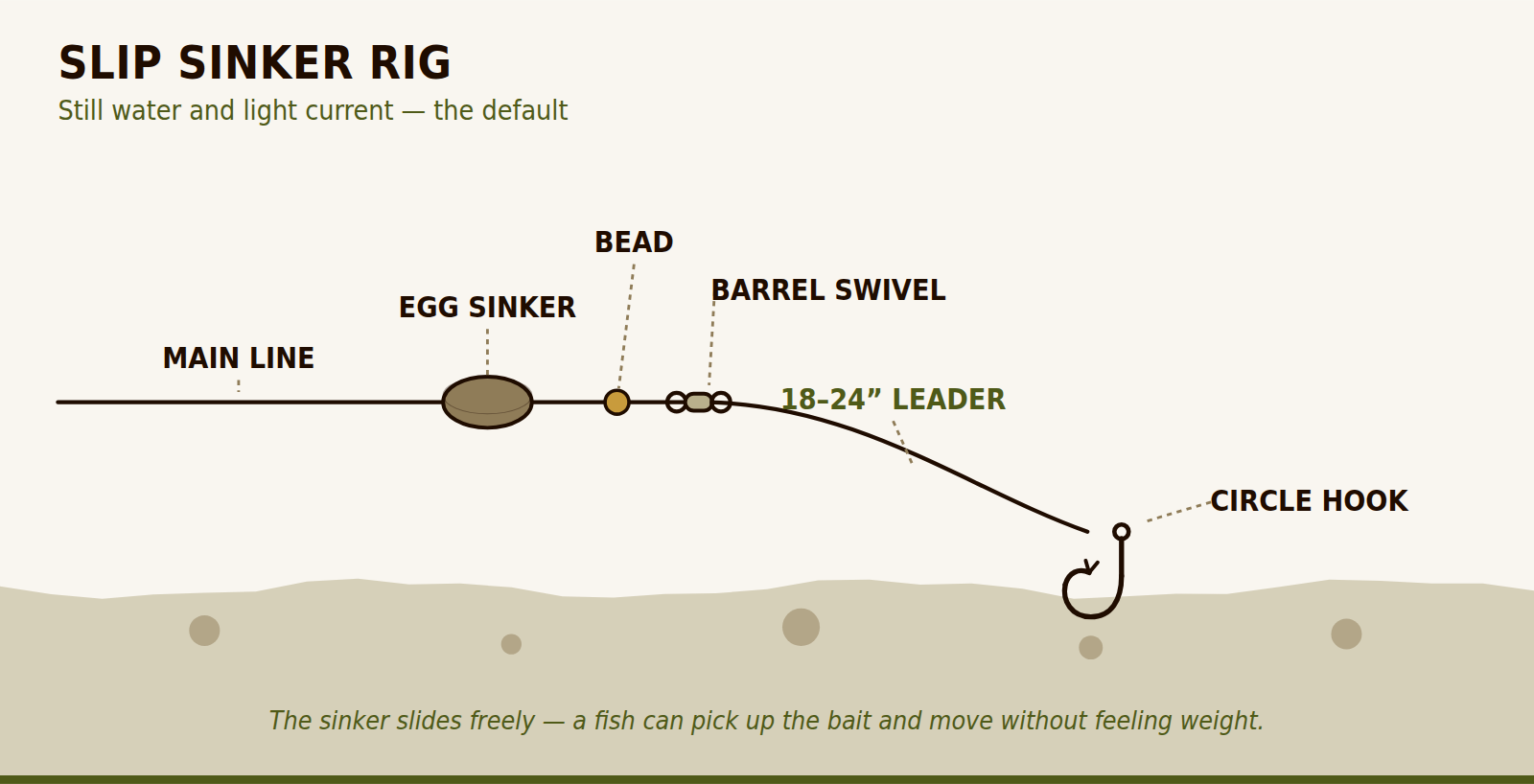
Leader length is your adjustment. Shorter (12–18 in) keeps bait tight to the bottom and is better in current. Longer (24–36 in) lets bait drift and wave in the water, which is better in still water and for wary fish.
I tend to opt for a 24 inch leader line most often. When fishing calm lakes, like I do, this allow for enough drift and at 24 inches, it’s just easier (or seems easier) to cast for me and my setup. As far as the fish being wary, perhaps it does make a difference on the length, but in my personal experience, the difference hasn’t been enough for me to notice. Maybe you have had different experience.
2. The Santee Cooper Rig
Use it when: soft mud, silt, weed, or anywhere a bait lying flat disappears.
Same architecture as the slip sinker rig, with one addition: a small peg float on the leader, an inch or two above the hook. That float lifts the bait off the bottom so it’s visible and mobile instead of buried in muck.
It’s named for the Santee Cooper lakes in South Carolina, where the bottom will swallow a bait whole, and it’s become standard anywhere the bottom is soft.
How to tie it:
- Build a slip sinker rig exactly as above.
- Before tying on the hook, slide a peg float onto the leader.
- Tie on the circle hook.
- Peg the float 1–3 inches above the hook.
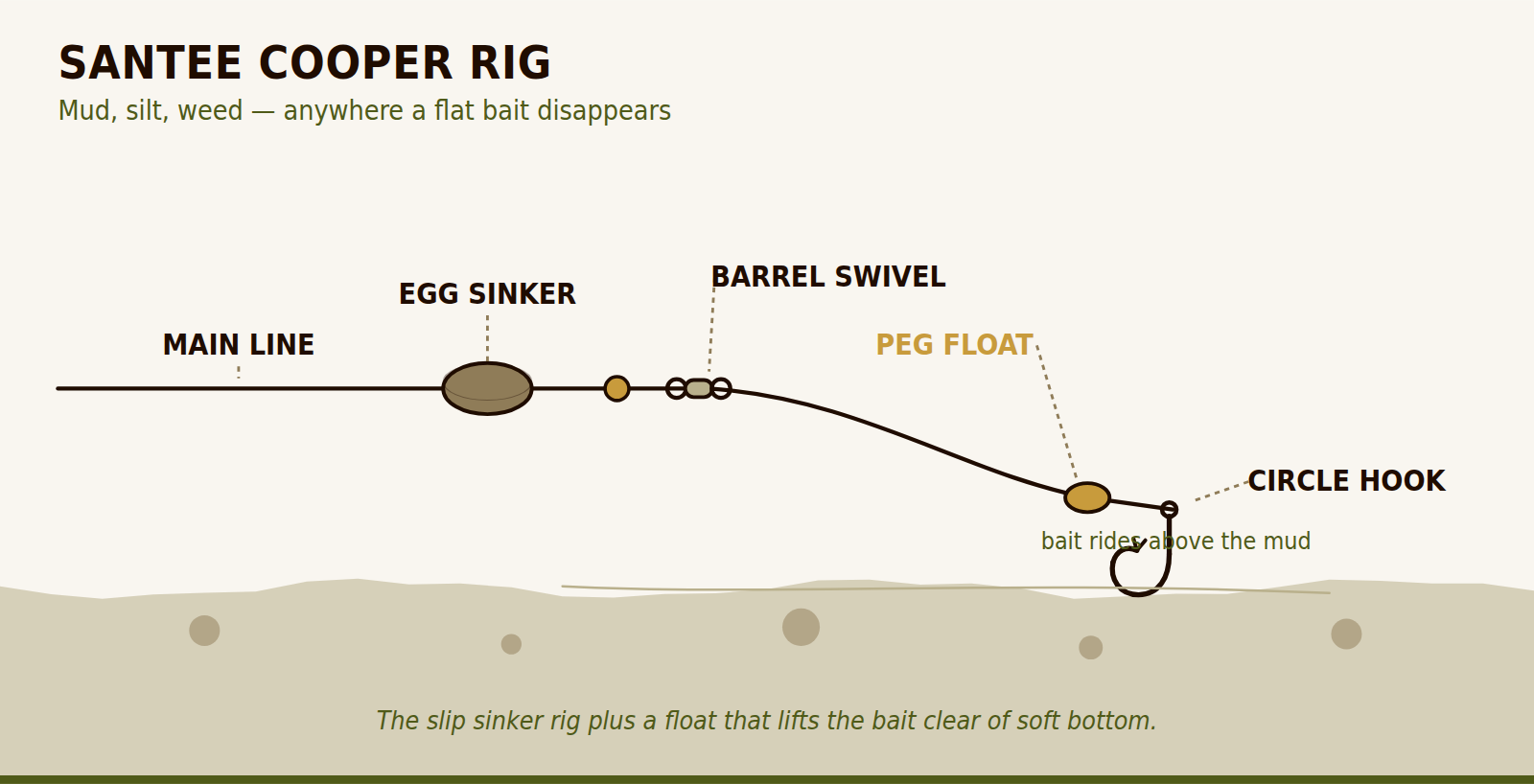
The float size does real work. Too small and it won’t lift a heavy bait. Too big and it drags in current and moves your bait somewhere you didn’t intend. Match it to your bait’s weight — a big cut bait chunk needs more float than a nightcrawler.
Getting that size right is most of the skill with this rig — the full Santee Cooper rig guide covers sizing, placement, and the conditions where you’re better off without it.
This rig also keeps your bait above most bottom-feeding nuisance fish, which is a quieter benefit people don’t mention enough.
3. The Three-Way Rig
Use it when: rivers, heavy current, and structure that eats terminal tackle.
A three-way swivel gives you two separate lines off the main: a short dropper to the weight, and a longer leader to the hook. This holds bait on the bottom in flow that would roll a sliding rig downstream.
How to tie it:
- Tie your main line to one eye of a three-way swivel.
- To the second eye, tie a short dropper (8–12 in) with a bank or bell sinker.
- To the third eye, tie a longer leader (18–30 in) with your circle hook.
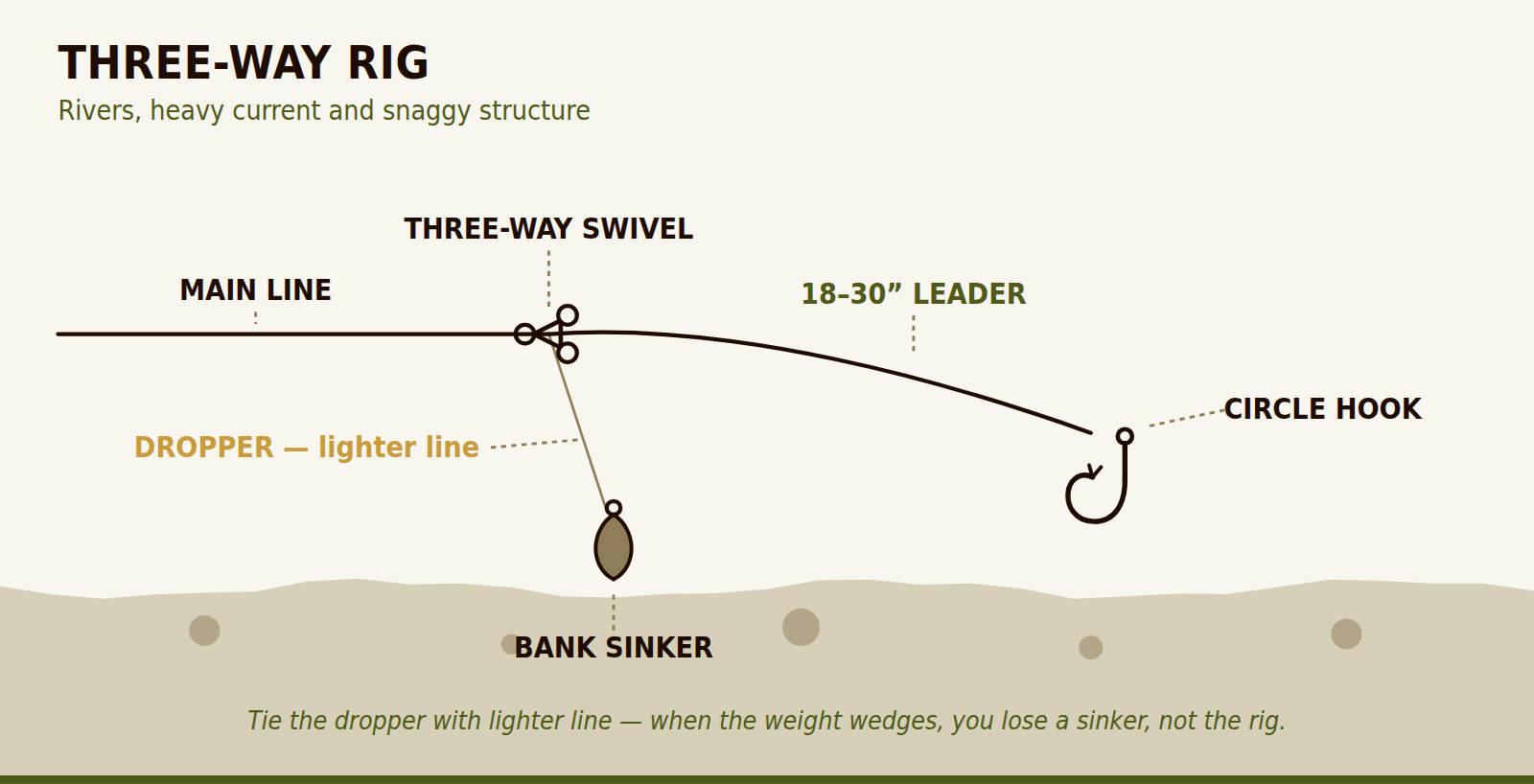
The trick most people miss: tie the dropper with lighter line than your main. When your weight wedges in rocks — and in a river it will — the dropper breaks first. You lose a sinker instead of the whole rig, and your hook, leader and swivel come back. Over a season on rocky water that’s a meaningful amount of tackle and re-tying time saved.
I tend to fish in rocky (large rocks) waters often and with that, comes snags, no matter the rig. I’d much rather lose a cheap sinker than my entire rig every time I snag.
4. The Slip Float Rig
Use it when: you need bait at a specific depth — over submerged timber, along current seams, or at night.
A fixed bobber limits how far you can cast, because you can’t reel a float past your rod tip. A slip float solves it: the float slides freely on the line and stops at a bobber stop you set wherever you want. Reel in and the float slides down to the weight for casting; hit the water and it slides back up to depth.
How to tie it:
- Thread a bobber stop onto your main line, then a small bead.
- Slide on the slip float.
- Tie on a barrel swivel — this stops the float sliding down past it.
- Add a 12–18 inch leader and your circle hook.
- Add just enough split shot to cock the float upright.
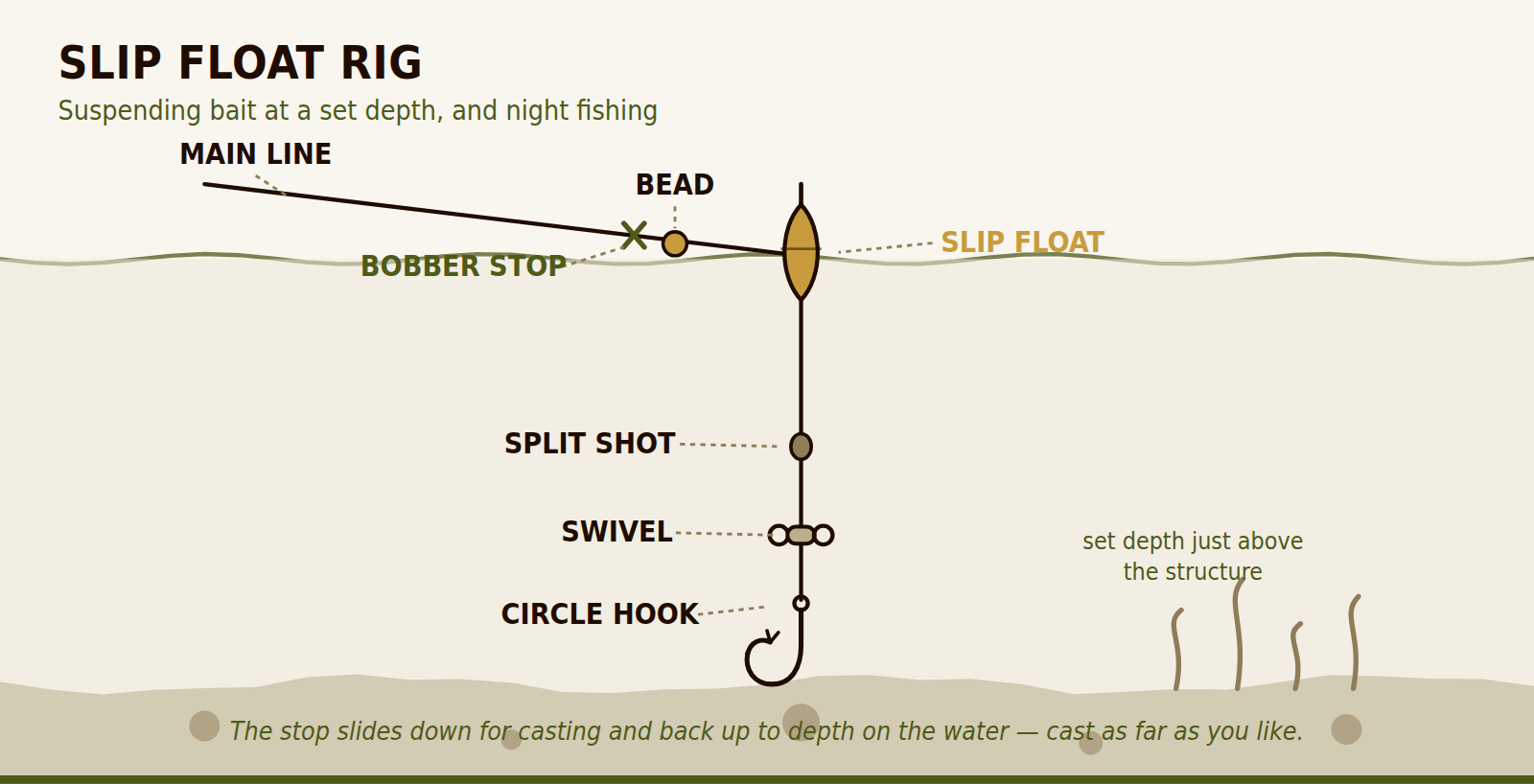
Set the stop so your bait hangs just above the structure, not in it. If you’re fishing an eight-foot hole over a brush pile topping out at five feet, set it around four.
This is also the night rig. A lighted slip float gives you a visible strike indicator in full dark, which beats staring at a rod tip you can’t see.
5. The Drift Rig
Use it when: fish are scattered and you need to cover water rather than wait.
The four rigs above are stationary — you put bait somewhere and wait for a fish to find it. Drifting inverts that: you move the bait until it finds fish. On a big flat or an open reservoir where cats are spread out, that’s far more efficient than anchoring and hoping.
How to tie it:
- Tie your main line to a bottom bouncer, or to a three-way swivel with a heavier sinker on a short dropper.
- Run an 18–36 inch leader to your circle hook.
- Add a peg float on the leader if the bottom is soft or snaggy.
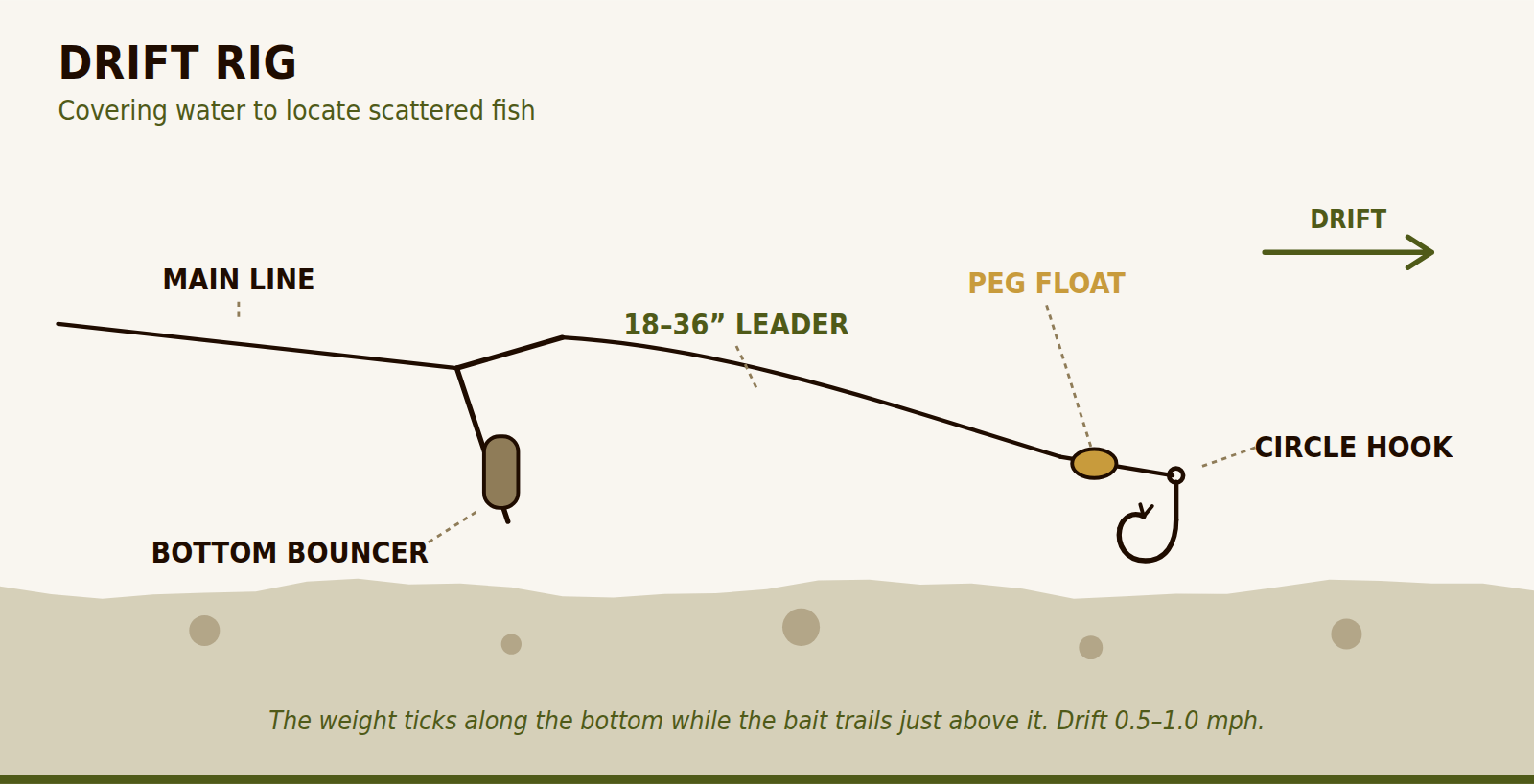
The weight ticks along the bottom while the bait trails behind it just above. Control your speed with a drift sock — most days you want a slow walking pace, roughly 0.5 to 1.0 mph. Faster than that and bait moves past fish before they commit.
Mark every fish you catch. The point of drifting is to find a concentration, and once you do, you can anchor and work it with a stationary rig.
Five Mistakes That Cost Fish
Too much weight. The most common rigging error there is. Use the lightest sinker that holds bottom. Extra ounces mean extra resistance, and resistance is what makes a cat drop a bait.
Setting the hook on a circle hook. Don’t. When the rod loads, tighten down and reel. Swinging on a circle hook pulls it straight out of the mouth — it’s the number one reason people try circle hooks once, lose fish, and go back to J-hooks.
The full comparison, including why offset circle hooks undo most of the benefit, is in the hooks guide.
It’s also worth looking at your rod. A stiff, fast-action tip works against a circle hook no matter how well you fish it — more on that in the guide to choosing a catfish rod.
Leaders too short. An 8-inch leader gives bait no movement at all. Start at 18 inches and adjust from there.
What you tie the leader from is its own decision — mono vs braid vs fluorocarbon covers it.
No bead on sliding rigs. A one-cent part. Without it, the sinker slams your knot on every cast until it fails — usually on a good fish.
Rigging the same way all day. If an hour goes by with nothing, change something. Depth, leader length, whether the bait’s on the bottom or above it. The rig is a variable, not a setting.
Frequently Asked Questions
What’s the best all-around catfish rig? The slip sinker rig. It works in the widest range of conditions and it’s the foundation the others build on. If you only learn one, learn this.
Do I really need circle hooks? You don’t need them, but they hook fish in the corner of the mouth rather than the gut, which makes releasing fish clean and easy. If you keep fish, they also mean less mess. The only adjustment is retraining yourself not to set the hook.
How heavy should my sinker be? The lightest one that holds your bait in place. Start at 1–2 oz in still water and go up until the rig stops moving downstream. Reaching for the heaviest sinker in the box is a habit worth breaking.
Can I use these rigs from the bank? All five, though the drift rig needs a boat or kayak to be worth much. The slip sinker and Santee Cooper rigs are the two most bank anglers use most.
What size hook for channel cats vs. blues? Size to the bait, not the fish. A 5/0 handles most cut bait chunks and works fine on channels and mid-size blues. Move to 7/0–8/0 when you’re fishing big baits for big fish.
Not sure which you’ve got? Catfish identification — the anal fin settles it, and in some states the species decides your bag limit.
Where to Go From Here
Tie the slip sinker rig first and fish it until it’s automatic. Add the Santee Cooper next — it’s a two-minute modification and it’ll cover the days when the bottom’s too soft for a flat presentation.
For me, and the type of fishing I do (mostly lake, calm water, night-time catfishing) the slip sinker rig is my go-to and what I would tie on your rod if you were going fishing with me 🙂
Give them all a try and find what works best for you and your fishing conditions and situation. Better yet, see if you can come up with your own catfish rig and let us all know what it is and why it worked for you!