Catfish Identification: Blue, Channel or Flathead?
This post contains affiliate links. If you buy through them I earn a small commission at no extra cost to you. As an Amazon Associate, I earn from qualifying purchases.
In Maryland, moving a live blue catfish from one body of water to another can cost you $2,500.
That’s the state’s own figure. Maryland’s Department of Natural Resources puts it plainly: it is illegal to transport live blue or flathead catfish into another body of water, and violators face a fine of up to twenty-five hundred dollars. The same agency asks anglers to remove and kill any blue or flathead they catch, and says outright that “catch and release of these fish is discouraged.”
Now picture the moment that matters. You’ve got a catfish in the net. Twenty-two inches, grey, whiskers, forked tail. Channel or blue?
If it’s a channel, it’s an ordinary fish and you do whatever you like with it. If it’s a blue, in that watershed, you have a legal obligation attached to it — and if you put it in a livewell and drive to another lake, you’ve committed a $2,500 offence without knowing.
Species identification in catfishing is usually presented as a piece of trivia. It isn’t. It’s the thing that decides which set of rules applies to the fish in your hands.
The short answer
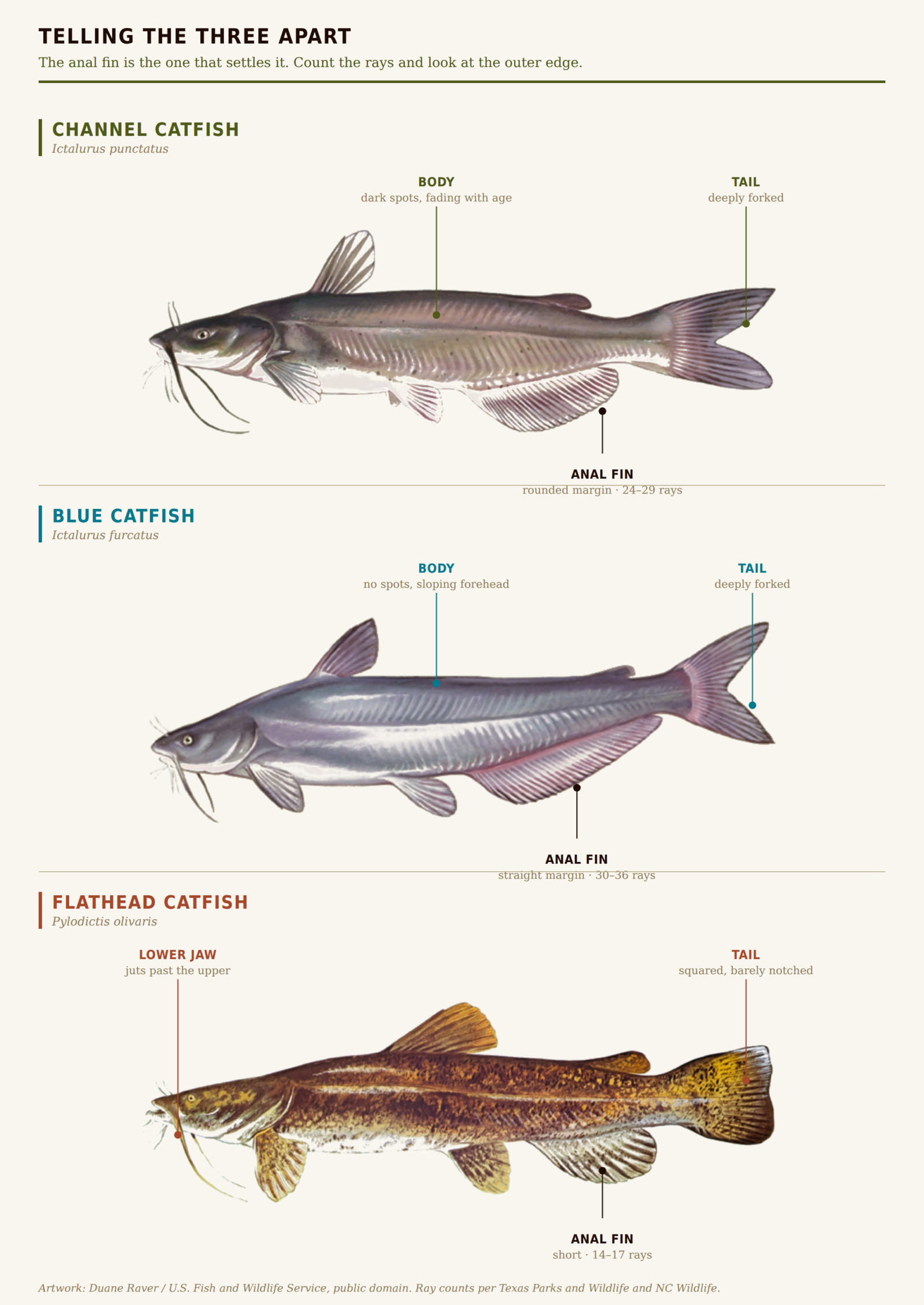
Look at the anal fin — the one on the underside, between the vent and the tail. Everything else is a hint; this is the test.
- Channel: outer edge is rounded, 24–29 rays
- Blue: outer edge is straight, like a razor, 30–36 rays
- Flathead: short and rounded, 14–17 rays, and the lower jaw sticks out past the upper
Color won’t do it. Size won’t do it. Whiskers won’t do it. Count the fin.
The one test that actually works
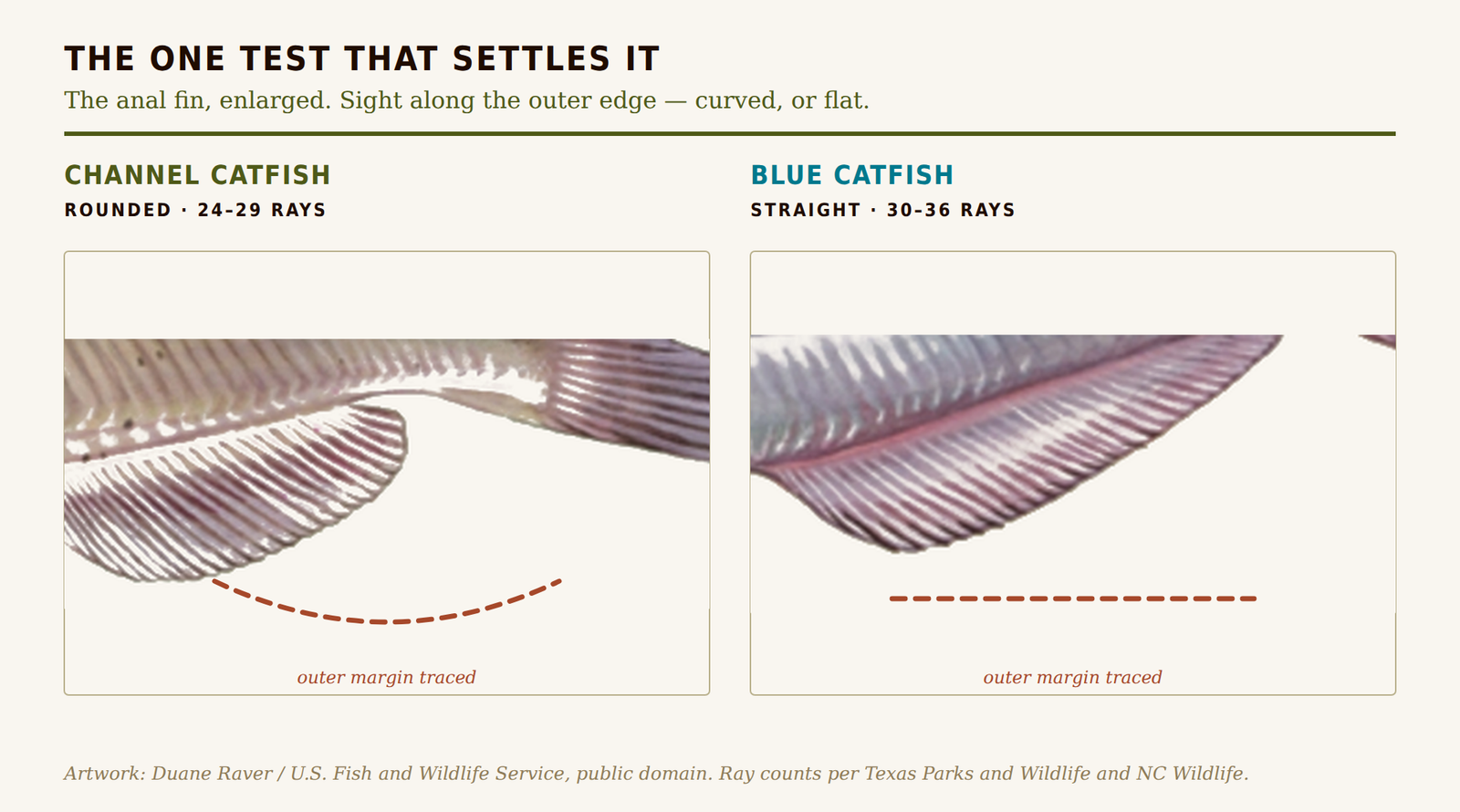
Texas Parks and Wildlife states the criteria without hedging. Channel catfish: “Outer margin of anal fin rounded, and anal fin with 24 to 29 rays.” Blue catfish: “Outer margin of anal fin straight, and anal fin with 30 to 36 rays.”
North Carolina Wildlife describes the blue’s anal fin edge as a “barber’s razor” — flat and even along its whole length. Once you’ve seen the two side by side that description does more work than any number.
For flatheads, Missouri Department of Conservation gives “anal fin is rounded, with 14–17 rays”, a tail fin “mostly squared off, with a slight notch (it is not deeply forked)”, and a lower jaw that projects beyond the upper. The Florida Museum of Natural History gives the same ray count independently.
You don’t have to count precisely in the dark on a riverbank. The shape of the outer edge — curved versus flat — is visible at a glance once you know to look, and the ray count is there to settle an argument.
The tells that don’t work
Nearly every wrong identification comes from one of these.
Color. A blue catfish is often not blue. Water clarity, depth and season all shift it, and a pale channel cat in clear water looks exactly like the blue people imagine. Channels run olive to slate grey; blues run grey to slate blue. The ranges overlap almost completely.
Spots. Channel catfish have dark spots — but Texas Parks and Wildlife adds the crucial qualifier: “spots may be absent in large adults.” An unspotted fish is not automatically a blue. Spots present means channel. Spots absent means look at the fin.
Size. This is the big one. Blues get much larger than channels, so people assume any big catfish is a blue and any modest one is a channel. But a twenty-pound channel cat exists, and so does a two-pound blue. Size tells you what’s likely, never what’s true, and “likely” is not a defence.
Whiskers. All three have them. All three have eight. They tell you it’s a catfish, which you knew.
A forked tail. Both blue and channel have deeply forked tails, which is what makes them confusable in the first place. It only rules out a flathead.
Blue versus channel: the hard one
These two are the pair that catch people out, because they overlap in color, share a body shape, and both have a deeply forked tail.
Work down in this order:
One. Spots? If the fish has scattered dark spots on the flanks, it’s a channel. Done. If it doesn’t, keep going, because a big channel may have lost them.
Two. The anal fin edge. Sight along the outer margin. A gentle curve means channel; a flat line means blue. This settles the great majority of fish.
Three. Count the rays if it’s genuinely close. 24–29 for a channel, 30–36 for a blue. The gap between the two ranges is small but real, and the fish will be still enough on a mat.
A fourth, softer cue: blues carry a more pronounced hump at the shoulder and a straighter slope from dorsal fin to snout. Channels look more streamlined. Useful once you’ve handled a few of each, and no substitute for the fin.
Flathead: the easy one
If there’s any doubt, there almost certainly isn’t a flathead involved. Three features and any one of them is decisive:
The tail is not forked. Squared, with at most a slight notch. Blues and channels both have deep, sharp forks. This alone identifies a flathead across a boat.
The lower jaw juts out. In everything but juveniles, the bottom jaw extends past the top — an underbite you can see from a distance.
Mottled brown and yellow. Missouri Conservation describes them as “pale yellow to light brown or olive, mottled with dark brown or black.” Nothing about a flathead reads grey.
Why it’s a legal question
Three separate ways an ID mistake becomes a citation.
Bag limits are set by species. Texas is the clean example. Blue and channel share a combined daily bag of 25, of which only 10 may be 20 inches or longer. Flathead is a separate limit of 5. A cooler with eight flatheads in it is legal under nobody’s reading if you thought they were channels — you’re three fish over a limit you didn’t know applied.
Length limits are set by species too. In the same Texas regulations, flathead carries an 18-inch minimum; blue and channel have no statewide minimum length. An undersized flathead is an offence; a channel cat the same length is dinner. Missouri goes further in places, setting a 24-inch flathead minimum at particular lakes.
Invasive status rewrites the rules entirely. Where blue and flathead catfish have been introduced, they stop being game fish and start being a management problem:
- Maryland asks anglers to kill blue and flathead catfish rather than release them, and makes moving one live into another waterbody a $2,500 offence.
- Georgia treats flatheads as an invasive predator in the Satilla, where an illegal release in the mid-1990s was followed by documented declines in redbreast sunfish, channel catfish and bullheads. The state runs an active removal programme.
In those waters, “I put it back” is the wrong answer, and returning a fish you’ve misidentified may be the violation.
The full picture on what varies is in catfishing regulations by state.
What to do when you’re not sure
Photograph the whole fish from the side, flat to the camera, with the anal fin visible and unobstructed by your hand. That single photo lets anyone settle it afterwards — and it’s the photo almost nobody takes, because hands cover the one fin that matters.
Don’t move it. Whatever the species, transporting a live catfish to different water is restricted or outright illegal in a lot of places, and it’s how flatheads got into the Satilla in the first place.
Check the regulations for the specific water, not just the state. Special-area rules override statewide ones constantly, and catfish limits are one of the most commonly varied.
Mistakes that cost people
Going by size. The most common error and the one that produces over-limit coolers.
Assuming a big unspotted fish is a blue. Large channel cats lose their spots. Check the fin.
Photographing the fish with a hand over the anal fin. Guarantees the question can’t be answered later.
Assuming release is always the safe choice. In invasive waters it may be the violation.
Reading statewide rules and stopping there. The lake you’re on may have its own.
Frequently Asked Questions
What is the difference between a blue catfish and a channel catfish? The anal fin. A channel’s outer margin is rounded with 24–29 rays; a blue’s is straight with 30–36. Channels usually carry dark spots, though large adults lose them. Color and size overlap too much to be reliable.
How can you tell a flathead catfish? The tail is squared or barely notched rather than deeply forked, the lower jaw projects past the upper, and the body is mottled brown and yellow rather than grey.
Do blue catfish have spots? No. Dark spots indicate a channel catfish. The reverse doesn’t hold — an unspotted fish may be a large channel that has lost its spotting with age.
Does the size of the fish tell you the species? No. Blues reach much greater sizes than channels, so size shifts the odds, but twenty-pound channels and small blues both exist. It’s never proof.
Why does catfish identification matter legally? Bag limits, length limits and invasive-species rules are all set by species. Texas gives flathead a separate daily limit of five with an 18-inch minimum, while blue and channel share a bag of 25. Maryland makes moving a live blue or flathead into another waterbody a $2,500 offence.
Should I release a blue catfish? It depends entirely on where you are. In its native range it’s an ordinary game fish. In the Chesapeake watershed, Maryland DNR discourages catch and release and asks anglers to remove them. Check the rules for your water.
How many barbels does a catfish have? Eight, on all three species. Barbels identify the family, not the species.
Where to go from here
The anal fin is the whole test. Everything else — color, size, spots, the shape of the head — is a hint that can be wrong, and being wrong has a price attached in more places than most anglers realize.
Once you know what you’ve caught, what catfish actually eat covers how differently the three feed, and the beginner’s guide covers where each one holds. If you’re still working out your terminal tackle, catfish hooks and catfish line cover the two components that matter most.
Reviewed September 2026. Regulations change — the figures here are current as of this date and are given as examples of how rules vary, not as a substitute for the current regulations for the water you are fishing. Always check with the relevant state agency before you keep or move a fish.
Sources
- Anal fin margin and ray counts for channel (24–29, rounded) and blue (30–36, straight); “spots may be absent in large adults” — Texas Parks and Wildlife Department, Catfish Comparison and Identification
- Blue catfish anal fin described as a “barber’s razor” — North Carolina Wildlife Resources Commission
- Flathead anal fin 14–17 rays, squared tail with slight notch, projecting lower jaw, mottled coloring — Missouri Department of Conservation; ray count corroborated by the Florida Museum of Natural History
- Texas bag and length limits: blue and channel 25 combined with only 10 at 20 inches or longer; flathead 5 with an 18-inch minimum — Texas Parks and Wildlife Department
- Missouri flathead 24-inch minimum at specified lakes — Missouri Department of Conservation
- Maryland: illegal to transport live blue or flathead catfish into another body of water, fine up to $2,500; catch and release discouraged — Maryland Department of Natural Resources
- Georgia: flathead catfish illegally introduced to the Satilla River in the mid-1990s, followed by documented declines in redbreast sunfish, channel catfish and bullheads — Georgia Department of Natural Resources, Satilla River Flathead Catfish Removal Project
- Species artwork — Duane Raver, U.S. Fish and Wildlife Service, public domain