Catfishing Regulations: What Actually Varies by State
This post contains affiliate links. If you buy through them I earn a small commission at no extra cost to you. As an Amazon Associate, I earn from qualifying purchases.
Catfishing regulations are the most confidently wrong subject on the fishing internet.
Ask whether limb lines are legal and you’ll get six answers in a forum thread, four of them stated as fact, none of them dated, and at least one from a bloke in a different state who is certain. It isn’t that people are careless. It’s that the question sounds like it has one answer and doesn’t.
Here’s the structural problem. Fishing regulations are set state by state. They’re revised annually. And almost every state’s headline rules are then overridden by a list of water-specific exceptions that nobody reads. So “is a jug line legal” has at minimum fifty answers, most of them with footnotes, and all of them with a date attached.
I’m not a lawyer and this post is not legal advice. What it is: a map of what varies, with real numbers from real agencies, so you know which questions to ask about the water you’re actually fishing. Every figure here is sourced and dated. Check it against your own state before you act on it — and if this post is more than a year old when you’re reading it, assume something has moved.
Most of what follows I don’t personally use. I fish rod and reel from the bank on lakes and reservoirs, so trotlines and jug lines are not my world. But they’re a huge part of catfishing, they’re where most of the legal trouble lives, and they’re the part the big sites skip entirely.
The short answer
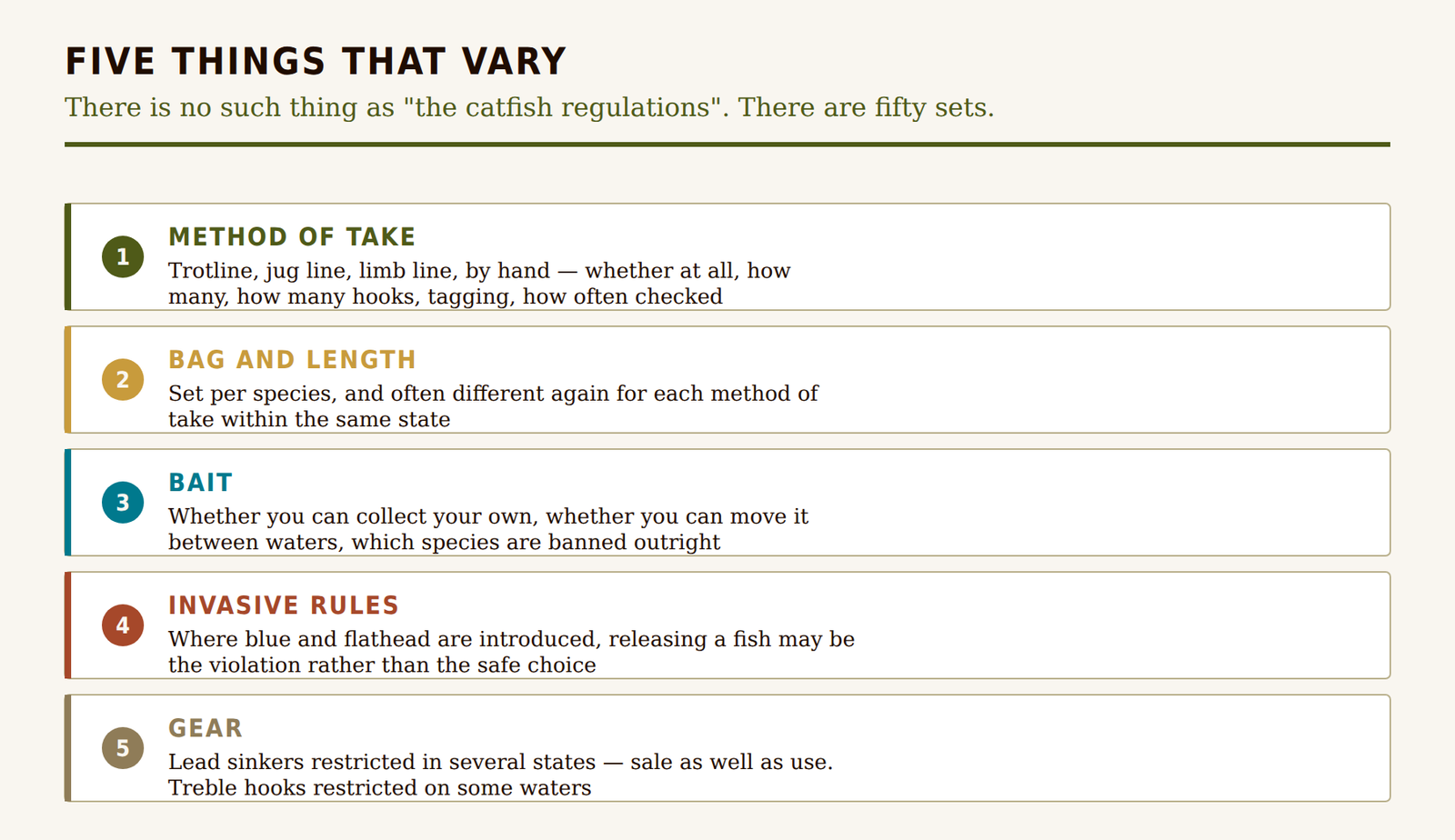
Five things vary, and they vary a lot:
- Method of take — whether you can use trotlines, jug lines, limb lines or your hands at all, and if so how many and with how many hooks
- Bag and length limits — set per species, and often different again for each method
- Bait — especially whether you can move live bait between waters
- Invasive species rules — which can invert the usual expectation that releasing a fish is the safe choice
- Gear — lead sinkers and treble hooks are restricted in places.
Find your state agency’s current regulations, read the statewide summary, then read the exceptions list for your specific water. The second part is the one people skip and it’s where the citations come from.
One: method of take
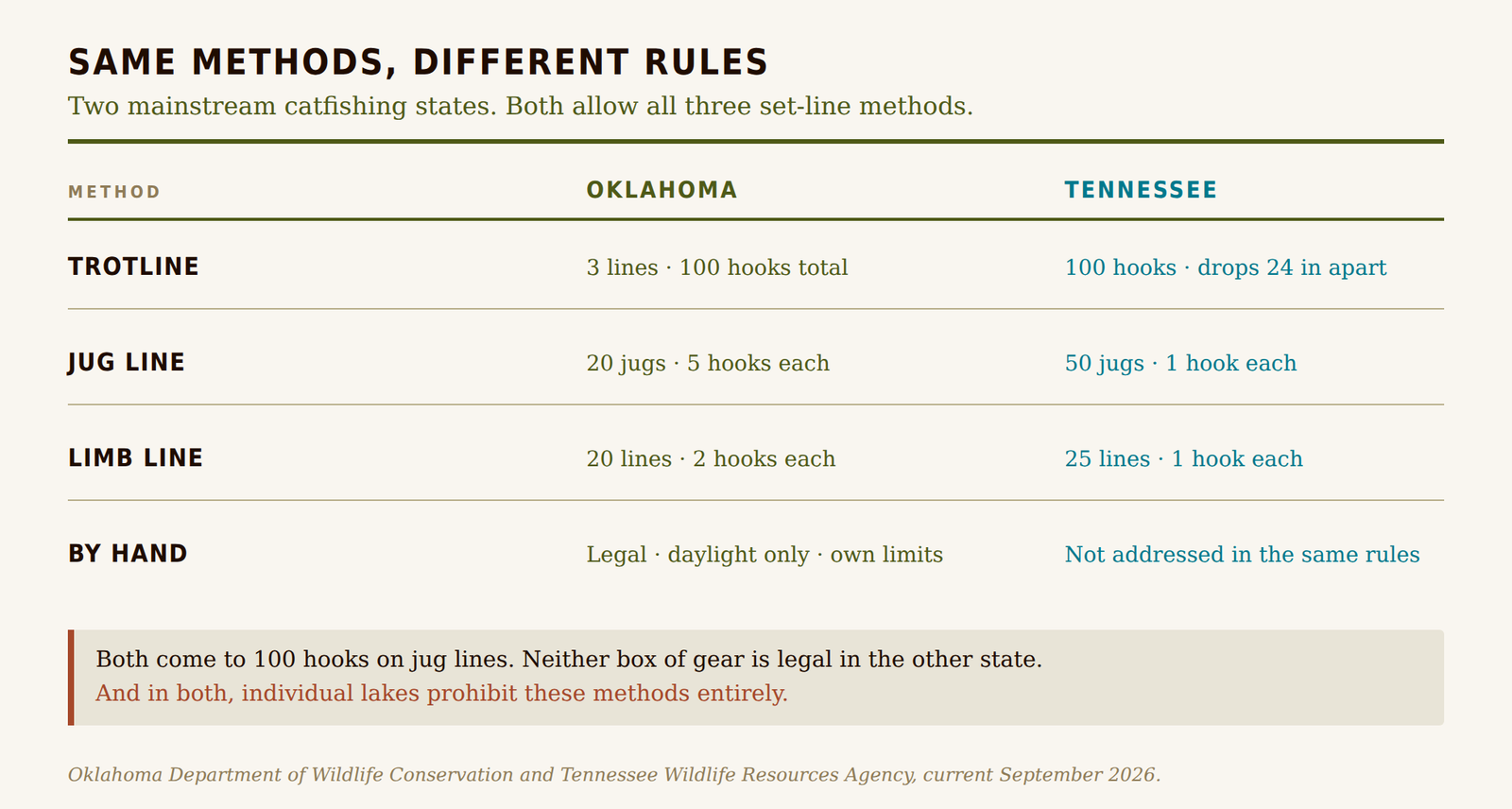
This is the biggest area of variation and the one most poorly served online. Two states, both of which allow all three methods, both perfectly mainstream catfishing states:
Oklahoma allows trotlines and throwlines at no more than three lines and 100 hooks per person. Jug lines: 20 per person, no more than five hooks per line, each tagged with your customer ID and attended at least once every 24 hours. Limb lines: two hooks per line, 20 lines per person, same tagging and daily attendance.
Tennessee allows trotlines with no more than 100 hooks, drop lines at least 24 inches apart, tagged within five feet of the bank, checked every 24 hours, and not set within 100 yards of dam mouths. Jug lines: 50 jugs, one hook each. Limb lines: 25, one hook each.
Same three methods. Oklahoma gives you 20 jugs with five hooks apiece; Tennessee gives you 50 jugs with one. That’s 100 hooks either way and two completely different sets of gear, and if you drove from one state to the other with a box of jug rigs you’d be illegal in one direction.
Hand fishing varies even more sharply. Oklahoma permits it — hands only, daylight hours, year-round, with its own limits of five flatheads and 15 blues and channels combined of which only one may be 30 inches or longer. You may not have hooks, gaffs, spears or ropes with hooks on you while doing it. Plenty of states don’t allow it at all.
And in Tennessee, several specific lakes prohibit these methods entirely regardless of what the statewide rule says. Which is the theme of this whole post.
Two: bag and length limits
Set by species, and sometimes set differently for each method of take within the same state.
Texas: blue and channel catfish share a daily bag of 25 in any combination, of which only 10 may be 20 inches or longer. Flathead is separate: 5 fish, 18-inch minimum length.
Oklahoma, noodling specifically: five flatheads with no size restriction, 15 blues and channels combined with only one over 30 inches.
Tennessee, trotlines: no limit on catfish, except only one fish may exceed 34 inches.
Missouri sets a 24-inch flathead minimum at particular lakes while the rest of the state runs differently.
Notice what those have in common: a rule about big fish. Most states have concluded the trophy end of the population is what needs protecting, and they’ve each solved it differently — a slot, a single-fish allowance, a minimum length. Notice also that three of those four are species-specific, which is why telling a blue from a channel is a legal skill and not a piece of trivia.
Three: bait, and the rule nobody knows
This is the one that catches honest people out, because it feels like it couldn’t possibly be regulated.
New York is a clear example. Wild-caught baitfish “may only be used in the same waterbody from which they were caught.” Uncertified baitfish bought from a dealer carry the same restriction. Certified baitfish — disease-tested, sold with a receipt showing species, quantity and date — can be moved and used anywhere legal, and you have to keep the receipt while you have the bait. Overland transport of personally harvested baitfish by vehicle is prohibited outside designated corridors. Carp, goldfish and round goby cannot be used as bait at all.
Read that again with a normal day in mind. You catch a dozen shiners in one lake, drive to another lake, and fish them. In New York, that’s an offence — and nothing about it feels like one.
If you’re using live bait anywhere, the questions to answer are: can I collect my own here, can I move it, does it need to be certified, and which species are banned outright. What catfish actually eat covers why live bait matters for flatheads; this is the part that decides whether you can legally do it.
Four: invasive species, where the logic inverts
Everywhere blue and flathead catfish have been introduced outside their native range, the usual assumption — that putting a fish back is the responsible choice — stops being true.
Maryland discourages catch and release of blue and flathead catfish outright, asks anglers to remove and kill them, and makes it illegal to transport live blue or flathead catfish into another body of water, with a fine of up to $2,500.
Georgia treats flatheads as an invasive predator in the Satilla River, where an illegal release in the mid-1990s was followed by documented declines in redbreast sunfish, channel catfish and bullheads. The state runs an active removal programme.
In those waters, the reflex that keeps you legal everywhere else is the thing that gets you in trouble. Worth knowing before you’re standing there with a fish.
Five: gear
Lead sinkers are restricted in several northeastern states — not just their use but their sale. Reporting for 2026 has New York prohibiting sale at half an ounce and under, Vermont under half an ounce, Maine and New Hampshire at one ounce and under, and Massachusetts restricting use under an ounce in inland waters. That catches split shot, which almost nobody thinks of as a sinker. Catfish sinkers covers why those thresholds are set where they are.
I’d verify each of those against the state’s own regulation before relying on it — I’m reading a compliance summary, not the statute, and this is exactly the kind of detail that shifts.
Treble hooks are restricted on some waters, which matters if you fish punch bait. Catfish hooks covers why a treble is the standard choice for prepared baits, and it’s worth checking the rule before you tie one on somewhere unfamiliar.
How to actually find your rules
Go to the state agency, not a blog. Including this one. Every state publishes current regulations free, usually as a searchable site and a PDF. That’s the only source that’s authoritative and the only one that’s current.
Read the statewide summary, then read the exceptions. Almost every state has a section titled something like “special area regulations” or “exceptions to statewide limits,” and it’s where your lake probably appears. People read the first part, assume they’re done, and get caught by the second.
Check the date. Regulations are typically revised annually. A PDF you downloaded two seasons ago is a historical document.
When it’s genuinely unclear, call them. State agencies answer the phone and would rather explain a rule than write a citation. That’s a better use of ten minutes than a forum thread.
Don’t trust a confident stranger, and that includes me. The figures in this post are sourced and dated below. They’re here to show you the shape of the problem, not to be the answer for your water.
Mistakes that cost people
Assuming the statewide rule is the rule. The exceptions list exists for a reason and your water may well be in it.
Assuming a method is legal because it’s traditional. Jug lines and limb lines are deeply traditional and comprehensively regulated — tagged, counted, and checked on a clock.
Moving live bait. The single most commonly broken rule in this post, and it rarely feels like breaking one.
Assuming release is always safe. In invasive waters it may be the violation.
Reading last year’s PDF. Or a blog post that never said when it was written.
Taking a forum answer as fact. It might be right. It’s also probably from somebody in a different state in a different year.
Frequently Asked Questions
Are limb lines legal? It depends entirely on the state, and often on the specific water. Oklahoma permits 20 limb lines with two hooks each; Tennessee permits 25 with one hook each; some waters within both prohibit them. There is no national answer.
How many hooks can I have on a trotline? Oklahoma caps trotlines and throwlines at three lines and 100 hooks per person. Tennessee caps a trotline at 100 hooks with drops at least 24 inches apart. Other states differ. Check yours.
Is noodling legal? In some states. Oklahoma allows hand fishing for catfish, hands only, during daylight hours, with its own bag limits. Many states prohibit it outright. It is one of the most variable rules in freshwater fishing.
Can I move live bait from one lake to another? Often not. New York restricts wild-caught and uncertified baitfish to the waterbody they came from and prohibits overland transport by vehicle outside designated corridors. Rules vary widely; assume you need to check.
Do catfish bag limits differ by species? Frequently. Texas gives blue and channel a combined bag of 25 with only 10 at 20 inches or longer, and gives flathead a separate bag of 5 with an 18-inch minimum.
Should I release a blue catfish? Depends where you are. In its native range it’s an ordinary game fish. In the Chesapeake watershed, Maryland asks anglers to remove them and makes moving one live a $2,500 offence.
Do I need to tag my jug lines? In the states covered here, yes. Oklahoma requires your customer ID on jug lines and limb lines, attended at least every 24 hours. Tennessee requires owner identification and daily checks. Untagged gear is a common citation.
Where to go from here
The honest summary is that there is no such thing as “the catfish regulations.” There are fifty sets of them, revised every year, with a list of exceptions underneath each one — and the difference between legal and not is usually a number you’d never think to look up.
None of which should put you off. Rod and reel from the bank, keeping a few channel cats within a bag limit you’ve actually read, is about as low-risk as fishing gets. It’s when you start setting lines, moving bait or handling fish that somebody else’s state considers invasive that the detail starts to matter.
Before you go: telling blue from channel matters legally in more states than most anglers realise, and the beginner’s guide covers the rod-and-reel fishing that most of these rules never touch.
Reviewed September 2026. This is not legal advice and I am not a lawyer. Every figure below is taken from the agency named and was current when this post was written. Fishing regulations are revised at least annually and are frequently overridden by rules specific to individual waters. Always confirm with the relevant state agency before you fish, set a line, move bait, or keep a fish.
Sources
- Oklahoma trotline, throwline, jug line, limb line and hand fishing rules, including hook and line counts, tagging, attendance and noodling bag limits — Oklahoma Department of Wildlife Conservation, Method of Take regulations
- Tennessee trotline, jug line and limb line rules, hook counts, drop spacing, tagging, 24-hour checks, dam proximity limits and the 34-inch trotline provision — Tennessee Wildlife Resources Agency, Methods Other Than Rod and Reel
- Texas bag and length limits for blue, channel and flathead catfish — Texas Parks and Wildlife Department
- Missouri flathead 24-inch minimum at specified lakes, and permitted methods of take — Missouri Department of Conservation
- New York baitfish regulations: certified and uncertified bait, same-waterbody restriction, overland transport and prohibited species — New York State Department of Environmental Conservation
- Maryland: catch and release discouraged for blue and flathead catfish; illegal to transport live fish of either species into another body of water, fine up to $2,500 — Maryland Department of Natural Resources
- Georgia: flathead catfish illegally introduced to the Satilla River in the mid-1990s and subsequent declines in native species — Georgia Department of Natural Resources
- Lead sinker sale and use restrictions in New York, Vermont, Maine, New Hampshire and Massachusetts — taken from a 2026 commercial compliance summary rather than the statutes themselves, and flagged in the text as requiring direct verification