Catfish Sinkers: Shape, Weight, and Why Yours Keeps Moving
This post contains affiliate links. If you buy through them I earn a small commission at no extra cost to you. As an Amazon Associate, I earn from qualifying purchases.
Your sinker has one job and it isn’t being heavy. It’s staying where you put it.
Those sound like the same thing. They’re not, and the difference is why people end up throwing four ounces of lead at a problem that two ounces of a different shape would have solved. A round sinker rolls. A flat one doesn’t. Get the shape right and you can fish lighter, cast further, and feel more — all of which matter more from the bank, where you can’t reposition the boat to change your angle on the drift.
That’s the whole post, really. Shape first, then weight, and only as much weight as the shape actually needs.
I fish rod and reel from the bank on lakes and reservoirs, so most of what follows is about holding a spot you’ve walked to and can’t easily change. There’s a section on lead near the end that I’d read even if you skip everything else.
The short answer
Still water, sliding rig: egg sinker, 1–2 oz. Cheap, rolls freely on the line, and its shape doesn’t matter because nothing is pushing it.
Current, or wind-driven drift on a big lake: no-roll or flat sinker, 2–4 oz. The flat profile is what stops it walking downstream. This is the upgrade most people skip.
Snaggy rock: bank or bell sinker. Compact, drops through gaps, and pulls free more often than a flat one wedged under a ledge.
Casting a long way from shore: bank or bullet shapes carry best. A flat sinker is an air brake.
The rule that covers everything: use the lightest weight that holds your bait where you want it, and change shape before you change weight.
The shapes, and what each one actually does
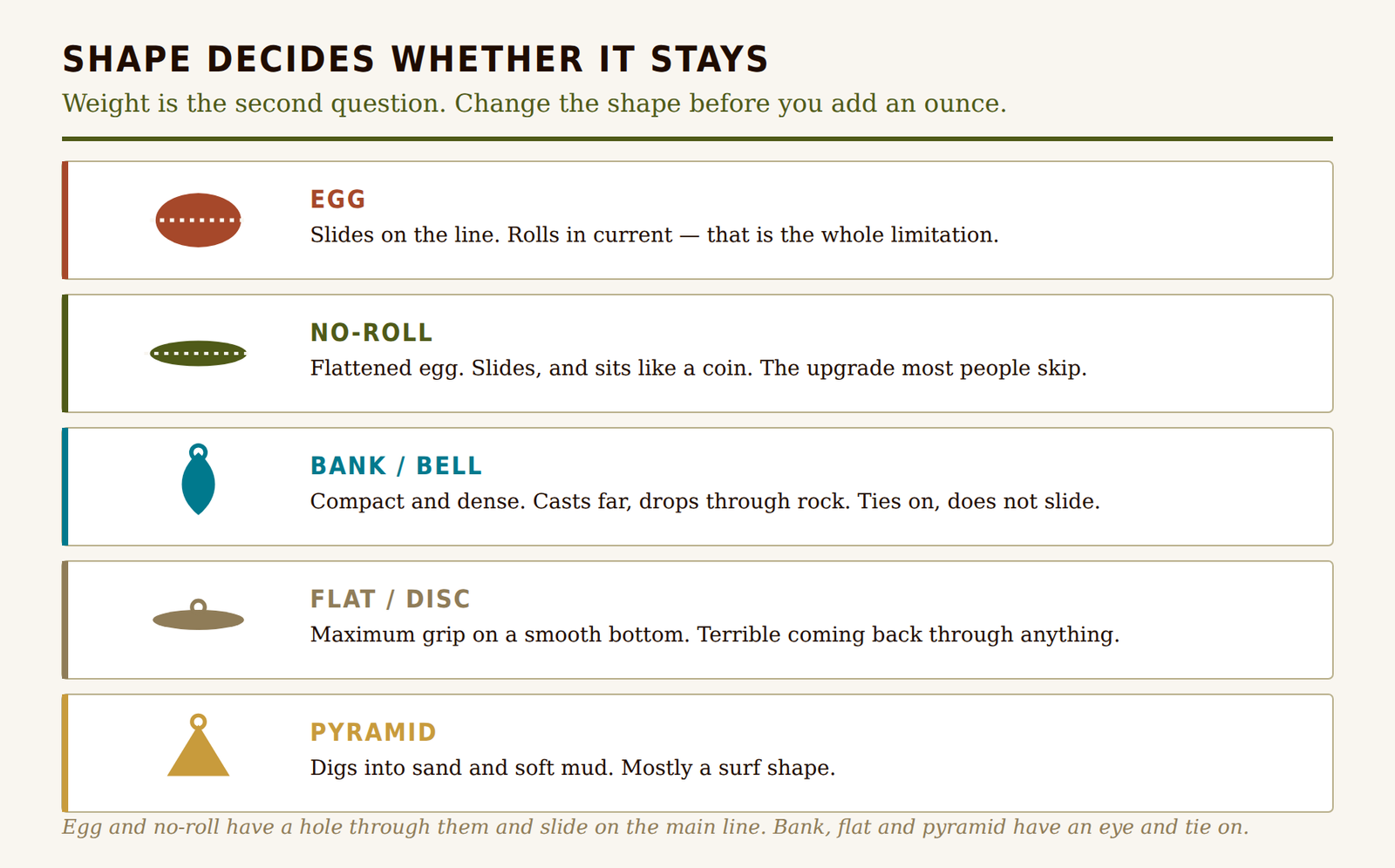
Egg sinker. Rounded, hole through the middle, slides on the main line. The default for slip rigs in still or slow water, and the reason is the sliding, not the shape — a fish picks up the bait and the line runs through the sinker without it feeling weight. In current, though, round is exactly wrong: it rolls. If your bait keeps ending up downstream of where you cast it, this is why.
No-roll (flat egg). Same sliding hole, but flattened into a disc. It sits on the bottom like a coin rather than a marble, and current pushes against a much smaller profile. This is the single most useful shape change for anyone fishing moving water, and it costs the same as an egg.
Bank sinker (also bell or dipsey). Teardrop with an eye at the top. Compact and dense, so it casts well and drops through rock and timber without wedging as readily as a flat shape. Tied on rather than sliding, so it’s the natural choice for a three-way rig where the sinker hangs off a dropper.
Flat / coin / disc. Maximum grip on a soft or smooth bottom. Excellent at holding, poor at coming back through anything, and it kills your casting distance. Use it when holding is the whole problem.
Pyramid. Digs into sand and soft mud. Mostly a surf and beach shape; occasionally useful on a big reservoir with a sand flat and wind-driven current.
Split shot. Not for holding bottom — for cocking a float or adding a fraction of an ounce to a leader. Worth its own mention because of what’s in the lead section below.
How much weight
The rule is simple and almost nobody follows it: the lightest weight that holds your bait where you want it.
Too much and you’ve given the fish something to feel and pull against, you’ve killed your bite detection, and you’ve made the whole rig a job to cast. Too little and your bait is somewhere downstream of the spot you picked, doing nothing.
Rough starting points:
| Conditions | Weight | Shape |
|---|---|---|
| Pond or still lake | 1–2 oz | Egg |
| Light wind drift on a reservoir | 2 oz | No-roll |
| Moderate river current | 2–3 oz | No-roll or flat |
| Heavy current | 3–5 oz | Flat, or bank on a three-way |
| Casting distance from the bank | 2–3 oz | Bank or bullet |
Then test it. Cast, let it settle, tighten up, and watch the line for a minute. If the line is slowly going slack or your rod tip is easing downstream, the sinker is walking. Change the shape first. Going from an egg to a no-roll at the same weight fixes more drift problems than adding an ounce does, and it costs you nothing in casting distance or bite detection.
Where the sinker sits
This matters as much as what it weighs, and it’s covered properly in the complete guide to catfish rigs — but the short version:
Sliding on the main line — slip sinker and Santee Cooper rigs. A fish takes the bait and line runs through the sinker without resistance. This is why egg and no-roll sinkers have a hole through them.
Fixed on a dropper — three-way rigs. The sinker hangs below the line junction on a short length of lighter line, so a snagged sinker breaks off and you keep the hook, the leader and the fish. Bank sinkers live here.
If you’re fishing rock and losing tackle, the dropper approach saves you money and frustration in a way that no sinker shape can.
From the bank specifically
Three things change when you’re standing on the shore rather than sitting over the spot.
You can’t reposition. A boat that’s drifting wrong moves upwind and re-drops. You get one angle, and the sinker has to do the work of holding it. That’s the argument for going to a no-roll earlier than a boat angler would.
Casting distance is a real constraint. A flat sinker is an air brake. If the spot you want is at the edge of your range, shape matters as much for getting there as for staying there — bank and bullet shapes carry, discs don’t.
Everything comes back over the same ground. Whatever’s between you and the fish, your rig crosses it twice. Which is the case for the dropper setup, and the reason line choice matters more from shore than most guides admit.
The lead problem
This is the part I’d read even if you skipped the rest, because it’s the thing almost nobody in catfishing talks about and it’s not close to a marginal issue.
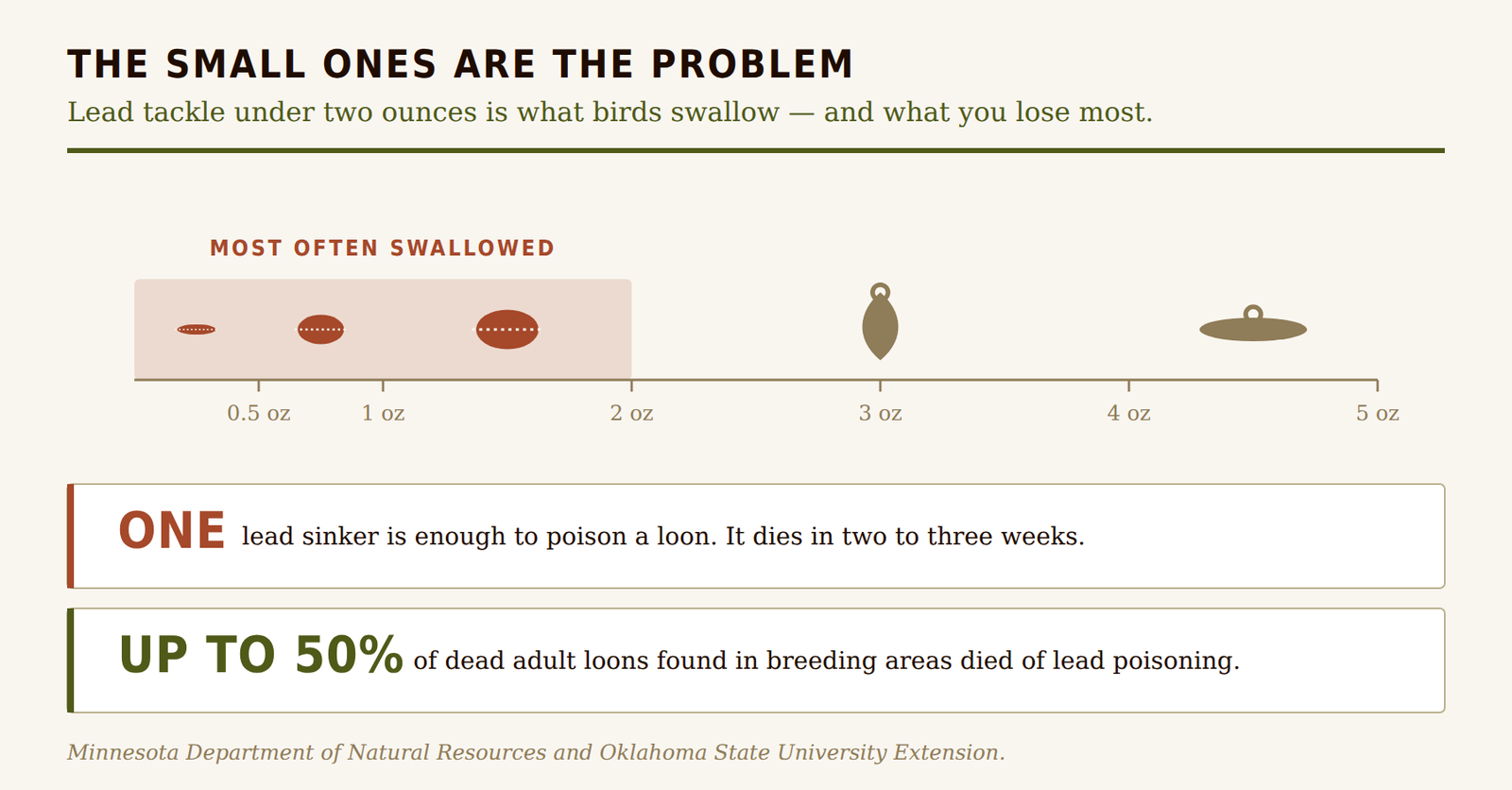
Minnesota’s Department of Natural Resources puts it plainly: “It takes only one lead sinker or jig to poison a loon.” A bird that swallows one typically dies within two or three weeks. In breeding areas, the same agency says lead poisoning from sinkers and jigs may account for up to 50 percent of the dead adult loons found by researchers.
Birds don’t eat sinkers on purpose. Oklahoma State’s extension service describes loons ingesting lead “incidentally as they are eating bait off broken fishing lines” — so this is tackle you lost, not tackle you threw away.
And here’s the detail that matters for what’s in your box: “Lead tackle under 2 ounces is most often consumed.”
Read that against the shapes above. Your 4 oz flat sinker is not the problem. Your split shot, your half-ounce eggs and the little stuff at the bottom of the tray are — the pieces you lose most often and think about least.
It also explains the regulations rather than just reporting them. The state sale bans covered in catfishing regulations by state are set at half an ounce and one ounce for exactly this reason. They’re not arbitrary thresholds; they’re the size range birds swallow.
The alternatives are real and available. Minnesota DNR lists bismuth, tin, stainless steel, tungsten, ceramic, recycled glass and natural granite. Tungsten is denser than lead, so you get the same weight in a smaller package — genuinely better for feel, and the reason bass anglers switched years ago. Tin and steel are cheaper and bulkier. For the small sizes, where the harm concentrates, the price difference on a season’s worth of tackle is not much.
I’m not going to tell you what to put in your tackle box. But the small sinkers are where the damage is, they’re the cheapest ones to replace, and it’s worth knowing that before you buy the next bag.
Mistakes that cost fish
Reaching for more weight instead of a different shape. The most common one. An egg in current rolls no matter how heavy it is.
Fishing too heavy in still water. Two ounces on a slip rig in a calm pond gives a fish something to feel. Go lighter than you think.
Tying a bank sinker straight into a sliding rig. It has an eye, not a hole. It won’t slide, and the whole point of the slip rig is gone.
Using a flat sinker where you’ll have to drag it back through rock. It holds beautifully and comes home never.
Never checking whether the rig actually stayed. Cast, tighten, watch the tip for a minute. Most people find out their sinker walked when they reel in.
Frequently Asked Questions
What size sinker is best for catfish? 1–2 oz in still water, 2–3 oz in moderate current, 3–5 oz in heavy current. The rule is the lightest weight that holds your bait where you want it — and change shape before you add weight.
What is a no-roll sinker for? Holding bottom in current. It’s a flattened egg sinker, so it sits like a coin rather than a marble and presents far less profile to moving water. It’s the most useful upgrade for anyone fishing rivers or a windy reservoir.
Should catfish sinkers slide or be fixed? Sliding for slip sinker and Santee Cooper rigs, so a fish feels no resistance when it picks up the bait. Fixed on a dropper for three-way rigs, where a snagged sinker is designed to break off and save the rest of the rig.
Are lead sinkers illegal? In some states, and the restriction often covers sale as well as use. New York, Vermont, Maine, New Hampshire and Massachusetts all restrict small lead sinkers. Check your own state — the rules turn on sinker weight, usually at half an ounce or one ounce.
What can I use instead of lead? Tungsten, tin, bismuth, steel, ceramic and glass are all available. Tungsten is denser than lead, so it’s smaller for the same weight and transmits feel better. Tin and steel are cheaper and bulkier.
Why does my sinker keep moving? Almost always shape rather than weight. A round egg sinker rolls in any current. Swap to a no-roll or flat sinker at the same weight before you reach for something heavier.
How do I stop losing sinkers in rock? Fish the sinker on a dropper of lighter line, as in a three-way rig, so it breaks off and you keep everything above it. Compact bank sinkers also pull through gaps better than flat shapes.
Where to go from here
Shape first, weight second, and the lightest that holds. If you take one thing from this: if your bait isn’t where you cast it, the answer is a flatter sinker, not a heavier one.
The sinker is one component of a rig and it only makes sense alongside the rest — the complete guide to catfish rigs shows where it sits in each of the five presentations, catfish hooks covers what’s on the other end, and catfish line covers what connects them.
Reviewed September 2026.
Sources
- “It takes only one lead sinker or jig to poison a loon”; death typically within two to three weeks; lead poisoning may account for up to 50 percent of dead adult loons found by researchers in breeding areas; blood lead thresholds of 0.2 ppm and 1.2 ppm; non-lead alternatives including bismuth, tin, stainless steel, tungsten, ceramic, recycled glass and granite — Minnesota Department of Natural Resources, “Get the lead out”
- Loons ingest lead “incidentally as they are eating bait off broken fishing lines”; “lead tackle under 2 ounces is most often consumed”; estimated 4,000 tons of lead sinkers purchased in the US annually — Oklahoma State University Extension, “Effects of Lead Ammunition and Sinkers on Wildlife”
- State-level restrictions on the sale and use of small lead sinkers — see the sourcing note in catfishing regulations by state