How to Catch Catfish: A Beginner’s Guide
This post contains affiliate links. If you buy through them I earn a small commission at no extra cost to you. As an Amazon Associate, I earn from qualifying purchases.
Most people picture a catfish as something that sits in one hole on the bottom and waits. It’s the reason beginners spend their first few trips changing bait at a spot where there are no fish.
Minnesota’s Department of Natural Resources tracks channel catfish that move many miles upstream every spring, often out of the main river and into smaller tributaries, then back downstream in autumn. Over a few years, individual fish have covered more than a hundred miles — through locks, and over dams.
The same agency describes both channel cats and flatheads in winter as so torpid in deep water that they can be found with “a fine dusting of silt” settled on them.
So a catfish is not a rock. It’s a fish that relocates seasonally, feeds hard at some water temperatures and shuts down at others, and holds in specific, findable places for specific reasons.
Which means the beginner’s real problem is almost never bait. It’s that the fish were not there.
This guide is built around that. Get the location right and ordinary bait catches fish. Get it wrong and the best bait in the world sits in an empty hole smelling wonderful.
The short answer
If you want to skip to a plan for Saturday:
Gear: a 7–7½ ft medium-heavy rod, a reel that holds 150 yards of 20 lb mono, 5/0 non-offset circle hooks, a few 1–2 oz egg sinkers, beads and barrel swivels.
Rig: a slip sinker rig. Sinker, bead, swivel, 18 inches of leader, hook.
Bait: fresh cut shad or whatever baitfish lives in your water. Chicken liver or nightcrawlers will do for channel cats.
Where: the outside bend of a river, the downstream side of a current break, or the edge of a drop-off in a lake. Near structure, near moving water.
When: last two hours of daylight into dark, once the water is above about 55°F.
The one rule: if nothing happens in 45 minutes, move. Don’t change bait. Move. On foot that means walking two hundred yards to the next point rather than reeling in and idling across a flat — which is harder to make yourself do, and matters more.
Everything below is why.
The three fish you’re actually fishing for
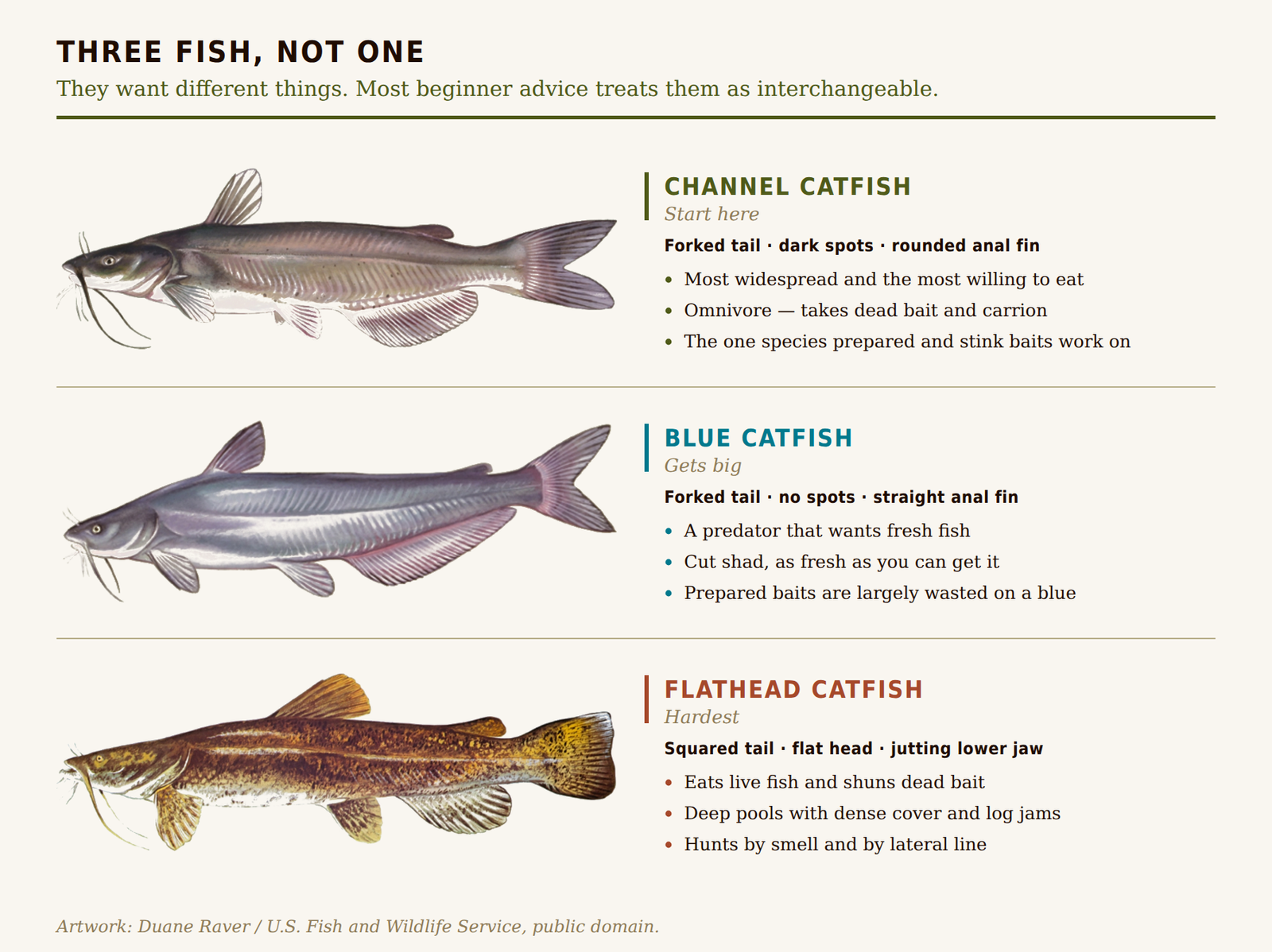
They are not interchangeable, and this is where a lot of beginner advice goes wrong by treating “catfish” as one animal.
Channel catfish are the ones you’ll almost certainly catch first. They’re the most widespread, the most willing, and the most forgiving. Minnesota DNR describes them as omnivorous — snails, crayfish, aquatic insects, small fish — and notes they are “much more likely than the flathead to feed on carrion or to take dead bait.” That’s the biology behind why prepared and stink baits work on channels and almost nothing else.
Blue catfish get much bigger and are predators that want fresh fish. Cut shad, in the water where shad live.
Flathead catfish eat live fish and largely ignore the rest. The same DNR profile has them holding in “deep pools with dense cover, such as log jams,” hunting by smell and by the vibrations their lateral line picks up, and shunning dead bait. A live bluegill near timber is the presentation; a chunk of cut bait mostly isn’t.
If you’re not sure which one you’ve landed, the tell is the anal fin — the one on the underside, ahead of the tail. A channel’s has a rounded outer edge and 24–29 rays; a blue’s runs straight, almost like a razor, with 30–36. A flathead’s is short and rounded with 14–17, and its lower jaw sticks out past the upper. Size won’t tell you anything: a big channel and a modest blue look identical until you check the fin.
Start with channel cats. They’re everywhere, they’ll eat a wider range of things, and they teach you the rest.
Not sure which one you’ve landed? Catfish identification has the test that settles it.
What you actually need
Less than the tackle shop would like you to think.
A rod. 7 to 7½ feet, medium-heavy, with a tip that loads rather than snaps. That matters more than it sounds — a stiff fast tip fights a circle hook instead of helping it. Choosing a catfish rod goes into why.
A reel with line. Any decent baitcaster or a solid spinning reel holding 150 yards. 20 lb monofilament is the right beginner main line: cheap, forgiving, and its stretch works with you rather than against you. Mono, braid and fluorocarbon covers when that changes.
Hooks. Non-offset circle hooks in 5/0. Check the packet says non-offset or inline — the offset version deep-hooks substantially more fish. Catfish hooks has the research on that and the sizing.
Terminal bits. Egg sinkers in 1 and 2 oz, a few 8 mm beads, barrel swivels, and leader material.
Nothing else yet. Not a rod holder, not an alarm, not a specialised net. Catch a few fish first and let the gaps tell you what to buy.
Where the fish are
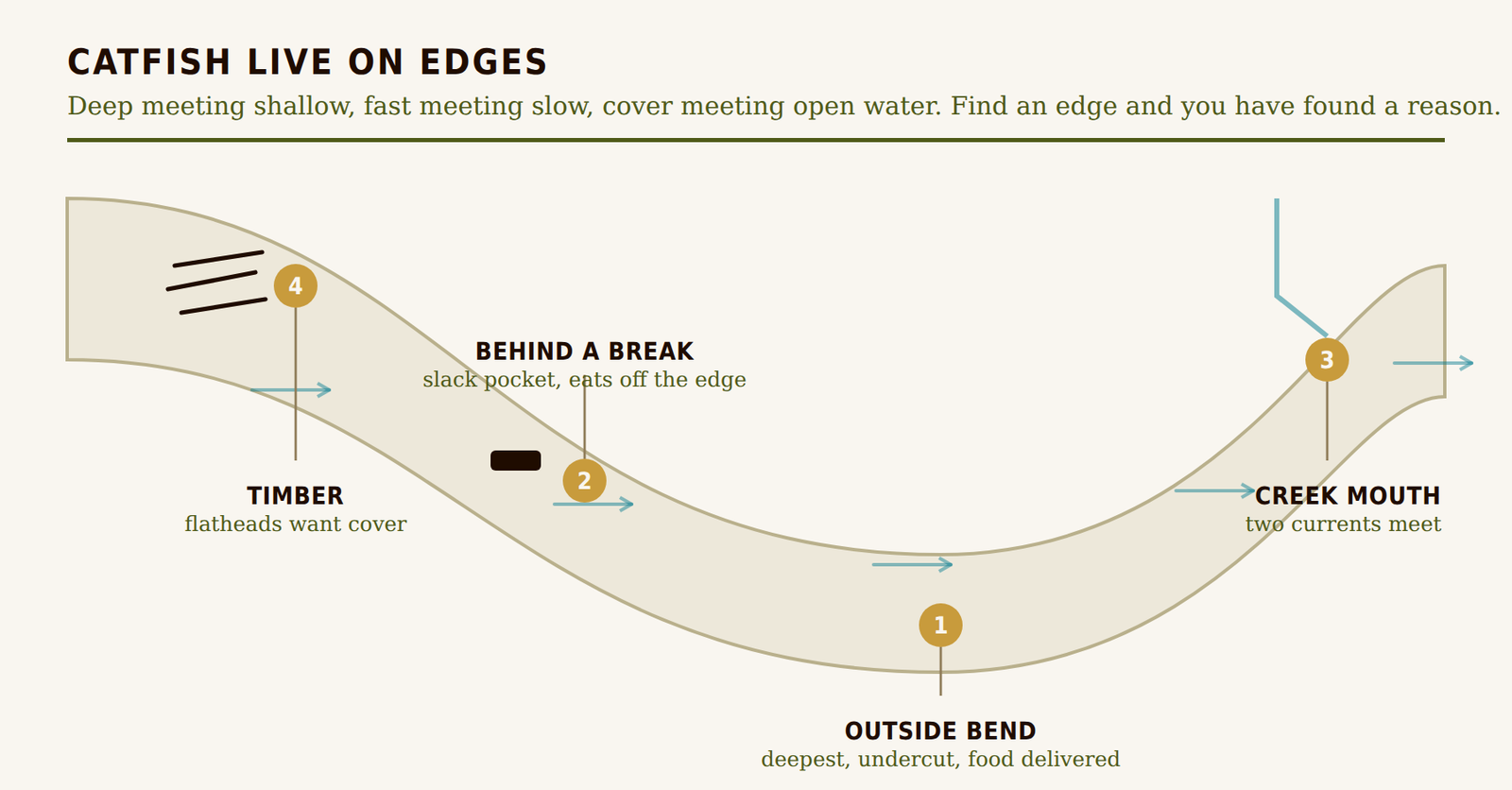
This is the part worth learning properly, because it’s the part that decides everything. And it’s the part every guide waves through fastest. “Fish the outside bend” is useful if you already know a river. If you’ve fished one spot your whole life because it’s the one somebody showed you, it isn’t advice, it’s a description of something other people can do. So here’s what you’re actually looking for, and why.
Catfish position themselves where moving water delivers food to them without costing them energy to hold position. Nearly every good spot is a version of that.
Outside river bends. Current cuts the outside of a bend deeper and undercuts the bank. Deeper water, structure, and a conveyor belt of food. If you fish one thing in a river, fish the outside bends.
Downstream of a current break. A wing dam, a bridge pier, a rock pile, a fallen tree. Fast water hits the obstruction, and a pocket of slower water forms behind it. Fish sit in the slack and eat what the current brings past the edge.
Where two currents meet. A creek mouth entering a river, or the seam where a channel meets slower water. Food concentrates on the seam.
Drop-offs and channel edges in lakes. Without current you’re looking for depth changes near flats where fish feed at night. The edge is the highway.
Log jams and timber, specifically for flatheads, which want cover more than current.
The pattern underneath all of these: an edge. Deep meeting shallow, fast meeting slow, cover meeting open water. Catfish live on edges. Featureless bottom in the middle of a lake is the least likely place to catch one, and it’s where beginners often end up because it’s easy to cast to.
When to go
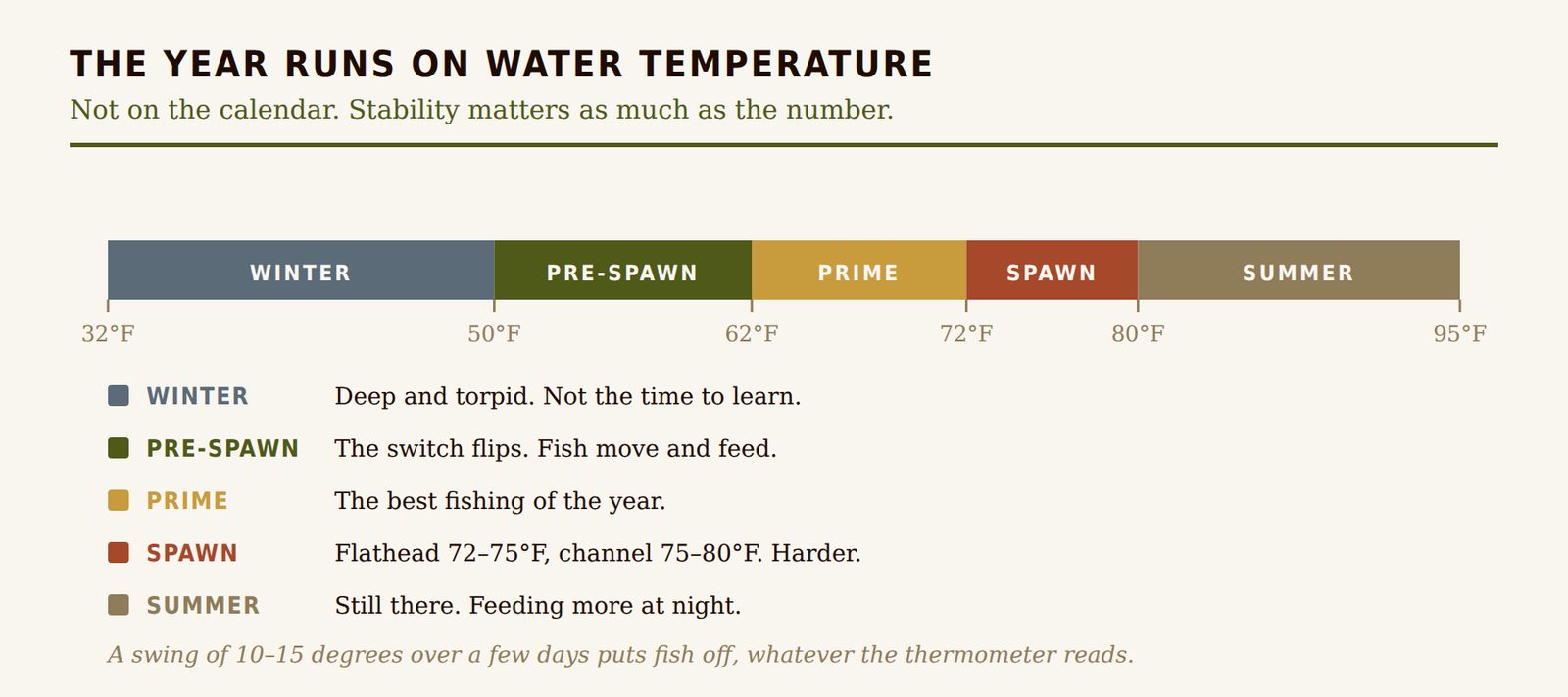
Water temperature drives the year more than the calendar does, and it explains where the fish have gone.
Below about 50°F — winter. Fish are in deep water and barely feeding. Catchable, but slowly, with small baits fished patiently. Not the time to learn.
About 50°F — the pre-spawn switch flips. Fish start moving and feeding. This is when channel cats begin running upstream toward the tributaries.
Rising through the 60s — the best fishing of the year. Fish are active, hungry, and predictable.
Spawn: flatheads at 72–75°F, channels at 75–80°F. Fishing gets harder mid-spawn. Fish move into cavities and holes to nest and stop eating for a stretch. Post-spawn they come back hungry.
Summer heat — channel cats tolerate water into the high 90s, so they’re still there. They just feed more at night, which is why night fishing has its reputation.
Falling back into the low 60s — the fall pattern. Fish feed heavily before winter and drift back downstream. Another excellent window.
One more thing worth knowing: it’s stability, not the absolute number. A swing of 10–15 degrees over a few days pushes fish off current and into structure and makes them sulky whatever the thermometer says. A steady week beats a warm one.
For your first trip: anything from 55°F up, last two hours of light into full dark.
Bait, briefly
Fresh beats everything, and it isn’t close.
A catfish finds food by following a chemical trail, using taste buds spread over its whole body. Frozen bait dumps most of its scent in the first few minutes and then goes quiet. A frozen chunk forty minutes down is, chemically, a piece of rubber with a hook in it.
Cut bait from the fish that live in your water is the best general answer. Shad, skipjack, bluegill where legal — whatever the local forage species is.
Worth being straight with you though: that assumes you’re catching your own, and I’m not. I fish the bank on lakes and reservoirs and my bait comes from a shop. If that’s your situation as well, buy the freshest cut bait available and change it every half hour, and use a good punch bait for channel cats without feeling like you’ve settled. What you cannot do without live bait is target flatheads — so don’t spend a season trying
What catfish actually eat has the full picture by species.
How to fish it
The actual sequence, start to finish.
One. Tie a slip sinker rig. Sinker onto the main line, then a bead, then a barrel swivel, then 18 inches of leader to the hook. The sinker slides freely, so a fish picking up the bait feels almost nothing.
Two. Cast to the edge, not into the middle. Let it settle. Take up slack until the line is just tight, and put the rod down.
Three. Watch the rod tip. A catfish bite is usually not a slam — it’s a tap, then a slow pull as the fish turns away with the bait.
Four. Do not set the hook. This is the single hardest habit to build and the one that decides whether circle hooks work for you. When the rod loads up, close the bail or engage the reel, let the rod bend, and start winding. The hook slides to the corner of the jaw and rotates in by itself. Swinging pulls it out of a mouth it hasn’t caught in yet.
Five. Keep steady pressure. Don’t pump, don’t give slack. Let the rod and the drag do it.
Six. Land it and mind the fins. The pectoral and dorsal spines will get you. Grip behind the pectoral fins from underneath, or use a lip grip and a wet towel.
When nothing is happening
Work down this list in order, one change at a time. This is the sequence that separates people who catch fish from people who sit.
- Has the bait been down more than 30 minutes? Change it. Scent output collapses long before bait looks used up.
- Is the bottom soft mud or weed? Your bait has disappeared into it. Add a peg float 2–3 inches above the hook — the Santee Cooper rig exists for exactly this.
- Is there current, and what is your rig doing? Rolling downstream means add weight. Pinned flat and dead means take weight off or lengthen the leader.
- Have you been here 45 minutes? Move. Forty-five minutes with no interest is the spot telling you something. Move before you change anything else.
- Could the fish be off the bottom? Change the depth, not the bait. Catfish suspend.
Notice how far down the list “change your bait” sits, and how high “move” sits. That ordering is the whole point.
Mistakes that cost beginners their first fish
Setting the hook. Covered above, and it’s the biggest one by a distance. Circle hooks don’t get set, they get pulled tight.
Fishing featureless water. Easy to cast to, no reason for a fish to be there.
Buying offset circle hooks by accident. They look nearly identical on the peg. Look down the shank from the eye — the point should line up, not kick sideways.
Staying put. Changing bait five times in one spot is four more changes than moving once.
Old bait. Fresh is not a preference, it’s the mechanism.
Too much hardware. A heavy sinker on a short leader in still water gives a fish every reason to drop the bait.
Frequently Asked Questions
What is the easiest way to catch catfish for a beginner? A slip sinker rig with a 5/0 non-offset circle hook and fresh cut bait, fished on the outside bend of a river or the edge of a drop-off, in the last two hours of daylight. Move spots after 45 minutes with no bites.
What is the best bait for catfish? Fresh cut bait from the species that lives in your water. Nightcrawlers, chicken liver and shrimp all work for channel catfish. Live baitfish is the answer for flatheads. Freshness matters more than the type.
Do you need to fish for catfish at night? No. They feed day and night. Night fishing is better in high summer because fish feed more actively once the heat comes off, and it’s quieter on the water — but a spring evening is easier and just as productive.
What size hook should a beginner use? 5/0 non-offset circle. It covers cut bait and most typical presentations, and a circle hook forgives the mistakes a beginner makes.
How do you hold a catfish without getting stung? Grip from underneath, behind the pectoral fins, keeping your hand clear of the spines in the pectoral and dorsal fins. A wet towel or a lip grip makes it easier. Larger fish are easier to handle than small ones.
How long should you wait in one spot? About 45 minutes. If nothing has shown interest by then, the fish aren’t there, and moving beats every other change you could make.
What water temperature is best for catfish? Fishing improves from about 50°F and is best through the 60s, then again in autumn as water falls back into the low 60s. Stability matters as much as the number — a swing of 10–15 degrees over a few days puts fish off.
Where to go from here
Catch a few channel cats on a slip sinker rig before you change anything. Almost every problem a beginner has is one of two things: the fish weren’t there, or the hook was set instead of pulled.
When you’re ready to go deeper, the five presentations are in the complete guide to catfish rigs, what goes on the hook is in catfish bait, and the terminal end is covered in catfish hooks and catfish line. If you’re buying a first rod, choosing a catfish rod will save you a bad purchase. And before you fish new water, check what the rules actually are there.
For me personally, I’m choosing summer nights 95% of the time. Anyone who has been catfishing for a little while will have a good summer night catfishing story or two!
Reviewed September 2026.
Sources
- Species identification criteria — anal fin margin and ray counts (channel 24–29 rounded, blue 30–36 straight) per Texas Parks and Wildlife and NC Wildlife; flathead 14–17 rays, squared tail and projecting lower jaw per Missouri Department of Conservation and the Florida Museum of Natural History
- Species artwork — Duane Raver, U.S. Fish and Wildlife Service, public domain
- Channel catfish seasonal movement (many miles upstream in spring, over 100 miles across years, through locks and over dams), winter torpor, spawning temperatures (flathead 72–75°F, channel 75–80°F), flathead habitat and feeding, channel catfish diet and willingness to take dead bait — Minnesota Department of Natural Resources, “Catfish biology and identification”
- Pre-spawn activity from about 50°F, spawn at about 70°F, fall pattern beginning in the low 60s, and the effect of 10–15 degree swings on fish behaviour — MidWest Outdoors, “Understanding Water Temperature and Catfish”