How to Choose a Catfish Rod: Power, Action, Length and What Actually Matters
This post contains affiliate links. If you buy through them I earn a small commission at no extra cost to you. As an Amazon Associate, I earn from qualifying purchases.
I didn’t always care about rod specification or really ever give it much thought. Growing up, all my rods were multi-purpose; Bass, Crappie, Catfish, Walleye, Bluegill, same rod. Maybe different line here and there. Then I started to get a little more serious about Catfishing and the do-it-all rods just weren’t producing the consistent results I wanted, especially after I started using circle hooks primarily. This guide will explain why rod choice actually matters and hopefully help you make an informed decision on your next catfish rod.
Most rod specifications were written with bass anglers in mind, and catfishing wants nearly the opposite of what a bass rod is built to do. Bass fishing rewards a stiff, fast, sensitive blank that transmits a light bite and drives a hook home on a hard swing. Catfishing rewards a rod that bends, absorbs, and lets a fish hook itself.
If you take a fast-action rod off the shelf because the packaging says “sensitive” and pair it with the circle hooks everyone told you to use, you have built a setup that will pull hooks out of fish. That’s not a bait problem or a technique problem. It’s the rod.
The short answer
If you want one rod and you don’t want to read the rest of this:
7’6″, medium-heavy power, moderate to moderate-fast action, fiberglass or composite.
That covers channel cats and mid-size blues from a bank or a boat, handles 2–4 oz of weight, throws cut bait without folding, and has a tip soft enough to work with circle hooks. It is the answer for most people fishing most water, and it costs well under $150.
Everything below is about when to deviate from that, and why.
Not sure you need this yet? The beginner’s guide has the minimum setup.
Power: how much it takes to bend the rod
Power is the rod’s resistance to bending — how much force it takes to load it. It’s rated on a scale that runs roughly ultralight, light, medium, medium-heavy, heavy, extra-heavy.
Power is not about the size of fish you can land. A medium rod will land a big catfish; it’ll just take longer and give you less control. Power is really about casting weight and lifting power — how much sinker and bait you can throw, and how hard you can pull a fish away from something it’s trying to get into.
| Power | Use it for |
|---|---|
| Medium | Small channel cats, light weights, finesse presentations |
| Medium-Heavy | The default. Channels and mid-size blues, 1–4 oz weights |
| Heavy | Big blues and flatheads, heavy current, 4–8 oz, fishing near timber |
| Extra-Heavy | Trophy specialists, heavy cover, big live baits |
Match power to the weight you’re casting, not to the fish you hope to catch. A rod rated for 1–4 oz that you’re loading with 6 oz will feel dead in the cast, and the odds of cracking the blank go up considerably.
The vast majority of my current catfish rod inventory is medium-heavy. I have a few heavy, but those only get used a couple times per year (hoping to get more use out of them soon).
Action: where the rod bends, and the one that matters most
Action describes where along the blank the rod bends. Fast action bends near the tip only. Moderate action bends through the upper third or half. Slow action bends through most of the blank.
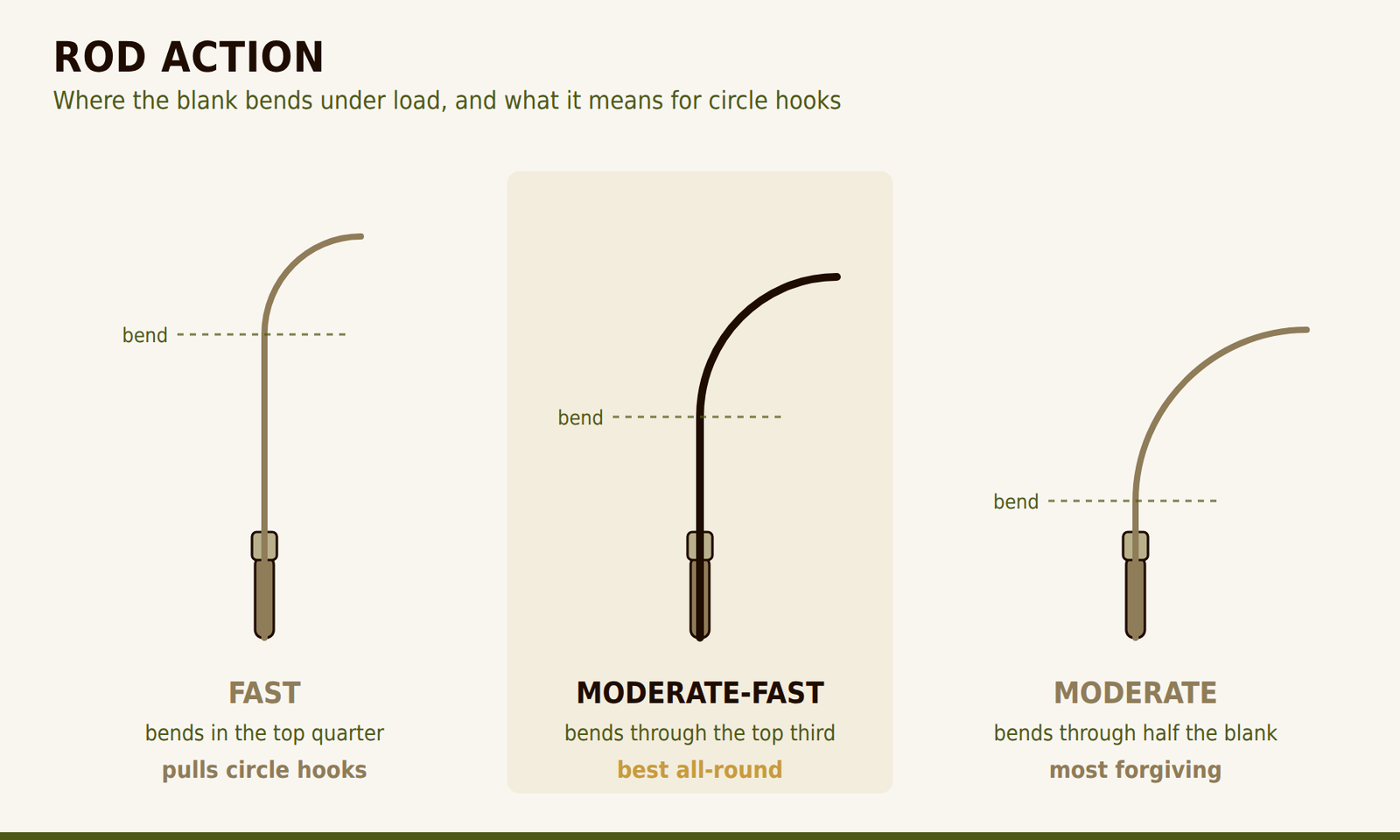
This is the specification most people get wrong, and it’s the one with the biggest consequences.
Fast action is the default recommendation for most freshwater fishing, because it gives you a rapid, powerful hookset. That’s exactly what you want with a J-hook and a hard swing.
It is exactly what you don’t want with a circle hook.
Circle hooks work by rotating in the fish’s mouth as the fish turns away, catching the corner of the jaw on the way. That rotation needs steady, increasing pressure — not a jolt. A rod that bends progressively applies that pressure smoothly. A stiff-tipped rod delivers a sudden load instead, and a circle hook that gets yanked comes straight back out.
Catfish Edge puts it plainly: a rod with very little flex in the tip will not work well with circle hooks. Wired2Fish makes the same point from the other direction — catfish frequently mouth a bait tentatively before committing, and a softer tip lets them take it without feeling resistance and dropping it.
So: moderate to moderate-fast. Enough backbone in the lower blank to move a fish, enough give in the top third to load properly and to keep the hook seated.
If you’ve tried circle hooks, lost fish, and gone back to J-hooks, there’s a decent chance the hooks were never the problem. My full breakdown of how circle hooks work is in the rigging guide.
Which hook you’re running matters as much as the blank — the hooks guide covers the types.
The line you pair with it matters just as much — mono, braid and fluorocarbon behave very differently on the same rod.
Length: casting distance versus control
Longer rods cast farther and pick up more line on a hookset. Shorter rods give you more control and are easier to handle in a boat or in tight cover.
- 7’0″ to 7’6″ — the general-purpose range. Works from a boat, works from a bank, easy to store and transport. If you’re buying one rod, buy in this range.
- 8′ to 10′ — for stationary bank fishing where you need to reach water you can’t get close to. Long rods hold line above near-shore snags and cast heavy weights a long way. You give up some sensitivity and they’re awkward to move around with.
- 12′ to 14′ — surf-style rods, for anglers casting big baits long distances at big blues from shore. A specialist tool, not a first rod.
Rule of thumb: if you’re moving, go shorter. If you’re planted and casting far, go longer.
Material: the one where instinct leads you wrong
Rod blanks are built from fiberglass, graphite, or a composite of both. The instinct — reinforced by every bass fishing article you’ve read — is that graphite is the upgrade. For catfishing that instinct is mostly wrong.
E-glass fiberglass. Heavy, extremely durable, forgiving, and cheap. It bends deeply and recovers slowly, which is exactly the behavior circle hooks want. This is the workhorse material for catfish rods and there is no shame in it.
S-glass fiberglass. Stronger than e-glass at nearly twice the modulus, and lighter. A genuine upgrade that keeps glass behavior while cutting weight.
Graphite. Much lighter and considerably more sensitive — and much more fragile. Catfishing involves heavy weights, abrasive structure, rods banging around in truck beds and rod holders, and sustained pressure from large fish. Graphite is the wrong trade for that environment more often than not.
Composite. Glass and graphite blended to get durability from one and sensitivity from the other. Genuinely good, and priced accordingly.
For channel cats you can fish anything. For blues and flatheads, glass or composite is the better answer, and the extra sensitivity of graphite buys you very little — a catfish taking a bait on a slack-line rig is not a subtle bite you need a sensitive blank to detect.
The parts that fail first
Blanks rarely break. What fails on a cheap catfish rod is the hardware, and it’s worth knowing where to look before you buy.
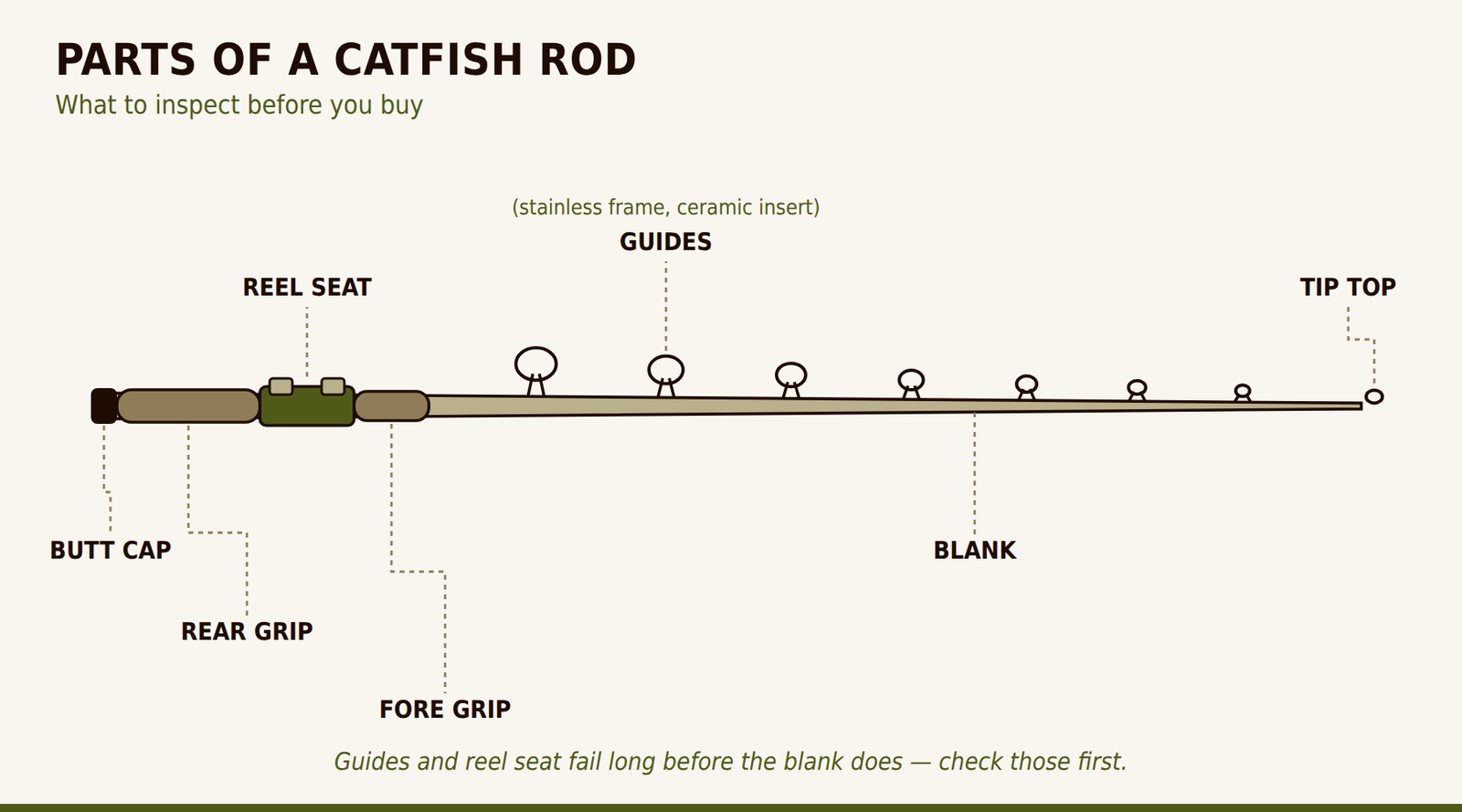
Guides. Look for stainless steel frames with ceramic or aluminum-oxide inserts. Cheap guides have inserts that crack or fall out, and a cracked insert will saw through braid in a season. Check that the inserts are seated smoothly — run a cotton swab around the inside and see if it snags.
The reel seat. This takes the entire load of a big fish. Graphite reel seats with metal hoods are standard and fine. What you’re checking for is whether the seat is locked to the blank or just glued on, and whether the locking rings thread smoothly.
The butt. If you fish from rod holders — and for catfishing you probably do — the butt cap takes constant abuse. A rubber gimbal or a solid cap outlasts a hollow plastic one.
Guide wraps. Look at the thread wraps holding each guide. Neat, fully sealed epoxy is a sign of decent build quality. Gaps, bubbles or exposed thread mean water gets in and the wrap fails.
Matching the rod to how you actually fish
| Your fishing | Length | Power | Action |
|---|---|---|---|
| Bank, channel cats, light weight | 7’0″–7’6″ | Medium to Medium-Heavy | Moderate |
| Bank, long casts for blues | 8’–10′ | Heavy | Moderate-Fast |
| Boat, general catfishing | 7’0″–7’6″ | Medium-Heavy | Moderate-Fast |
| Drifting or trolling | 7’6″–8′ | Medium-Heavy | Moderate |
| Flatheads in heavy timber | 7’–7’6″ | Heavy to Extra-Heavy | Moderate-Fast |
Rods that come up consistently
A note on how this list is built, because it matters. These are rod families that appear repeatedly in catfishing communities and in specialist coverage, and their specifications match what’s recommended above. I have not personally fished every one of them, and I’m not going to pretend otherwise — that’s the standing policy on this site, explained on the about page. Verify current specs and pricing before you buy; manufacturers revise lineups constantly.
- Ugly Stik Catfish Special — available from 7′ to 10′, medium-heavy, moderate action, glass-graphite composite. The default budget recommendation for a reason: it’s nearly indestructible and it costs less than a tank of gas.
- B’n’M Silver Cat Elite — around 7’6″, medium-heavy, one-piece. B’n’M builds specifically for catfish anglers rather than adapting a bass blank.
- B’n’M The Bomber — around 7’6″, casting, medium power. A lighter option for channel cats and smaller water.
- Catch the Fever Hellcat — around 7’6″, available from medium through extra-heavy. Aimed at anglers targeting big fish who want to pick a power rating precisely.
What not to spend money on
Premium sensitivity. You are fishing a bait on the bottom and watching a rod tip. The bite that matters is not subtle.
A rod for every situation, on day one. Buy the 7’6″ medium-heavy, fish it for a season, and let your actual frustrations tell you what the second rod should be.
Matched sets of four. Rod-holder spreads look impressive and there’s a real argument for multiple lines where it’s legal. But buying four rods before you know what you like is how people end up with four rods that are all slightly wrong.
Upgrading the rod when the problem is the rig. More catfishing problems are solved by changing leader length or sinker weight than by changing rods.
Frequently Asked Questions
What size rod is best for catfish? 7’6″ is the most useful single answer. It casts far enough for most bank fishing, stays manageable in a boat, and handles the weight range most catfishing requires.
Medium-heavy or heavy? Medium-heavy unless you’re specifically targeting big blues or flatheads, fishing heavy current, or casting more than 4 oz. Heavy rods are less pleasant to fish all day and don’t help with average fish.
Can I use a bass rod for catfish? For small channel cats, yes. The limitations show up fast: most bass rods are rated for far less casting weight, and fast action works against circle hooks. It’ll catch fish. It’s not what you’d choose.
Is fiberglass really better than graphite for catfishing? For durability and circle-hook performance, yes. Graphite’s advantages — light weight and sensitivity — matter less in catfishing than in almost any other freshwater discipline, while its fragility matters more.
Do I need a baitrunner or clicker reel? Not strictly, but it solves a real problem: letting a fish take line without pulling the rod out of the holder. If you fish multiple rods in holders, it’s worth the money more than a rod upgrade is.
Spinning or baitcasting? Baitcasting handles heavy weights and heavy line better and dominates serious catfishing. Spinning is more forgiving to learn. If you already cast one comfortably, start there.
Where to go from here
Buy one rod in the middle of the range, fish it for a season, and pay attention to what actually annoys you. That complaint is the specification for your second rod, and it’s better information than any buyer’s guide can give you.
Then get the rest of the setup right, because a good rod on a badly built rig catches nothing.
How to Rig for Catfish: 5 Rigs That Cover Almost Every Situation
I hope this article helps you make a solid, informed decision on your next catfish rod purchase. If it just overwhelmed you more and your analysis paralysis is keeping you from fishing, BUY THIS and go fish: Ugly Stik Catfish Spinning Rod Combo.
You’re welcome.