Catfish Hooks: Circle, J-Hook, Kahle and Treble Compared
This post contains affiliate links. If you buy through them I earn a small commission at no extra cost to you. As an Amazon Associate, I earn from qualifying purchases.
There is a good chance the circle hooks in your tackle box aren’t doing what you think they’re doing.
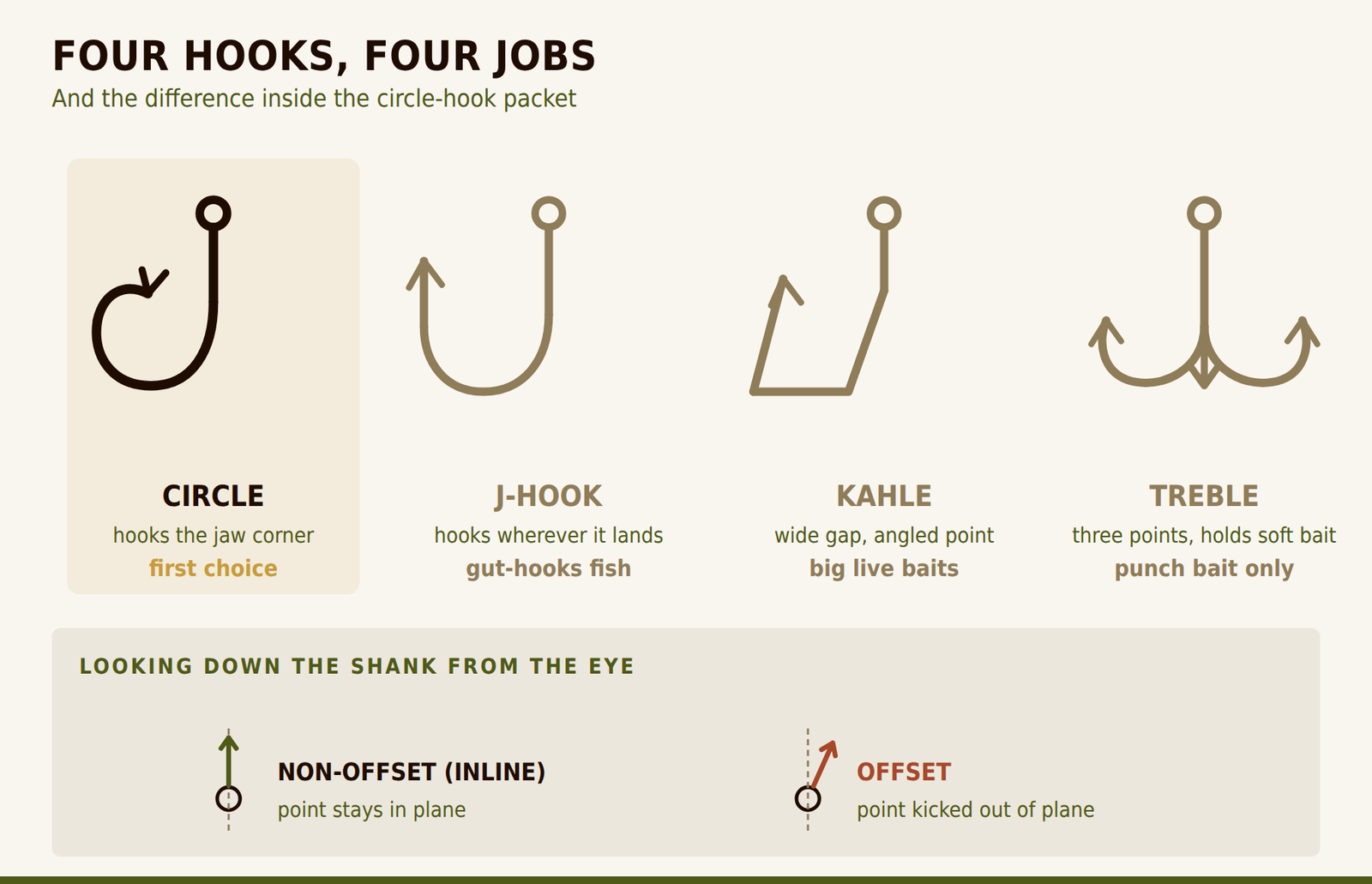
Circle hooks come in two versions, and most packets on a shop wall don’t make the difference obvious. On a non-offset — sometimes sold as “inline” — the point sits in the same plane as the shank. On an offset, the point is bent out to one side. They look almost identical hanging on a peg. They do not behave alike.
South Carolina’s Department of Natural Resources summarises the research on red drum: non-offset circle hooks gut-hooked 5–10% of fish, against 35–40% for J-hooks. Offset circles landed at 23% — roughly halfway back to a J-hook, with mortality about the same as one.
That’s red drum rather than catfish, and it’s worth being straight about that. But the mechanism is not species-specific: a circle hook works by rotating in a closing mouth until it catches the jaw corner, and bending the point out of plane interferes with that rotation whatever is doing the swallowing. If you buy circle hooks for the reason people usually buy them, buying the offset version throws most of the benefit away.
Check the packet. If it doesn’t say non-offset or inline, look down the shank from the eye — the point should line up, not kick sideways.
The short answer
If you don’t want the rest:
Non-offset circle hooks, 5/0 to 8/0, sized to your bait. That covers channel cats and blues on cut bait, which is most catfishing most of the time.
Keep a few Kahle hooks in 2/0–5/0 for big live baits, and a packet of size 6 trebles if you fish punch bait. Skip J-hooks unless you have a specific reason, and the rest of this explains what those reasons are.
The parts, and which ones matter
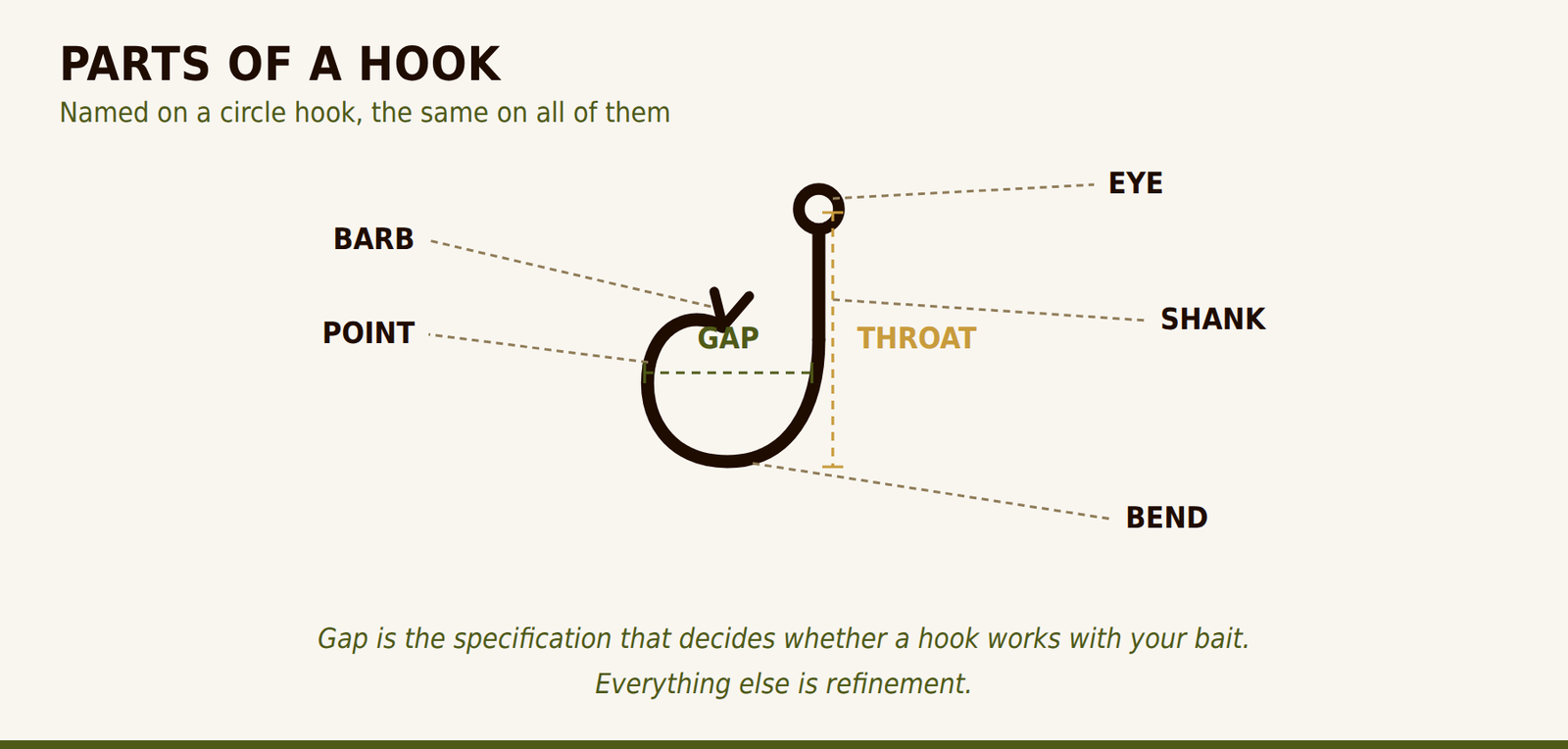
Most hook specifications describe three things: the gap (point to shank), the throat (how deep the bend runs), and the shank (eye to bend). Gap is the one that decides whether a hook works with your bait — a big chunk of cut shad on a narrow-gap hook leaves no room for the point to reach anything.
Everything else is refinement. High-carbon steel holds a point longer than cheap wire. A forged bend resists opening under load, which matters on a big flathead and not at all on a two-pound channel cat. Chemically sharpened points come sharper out of the packet and dull at about the same rate as any other.
The four types
Circle hooks
The point curves back toward the shank, almost closing the gap. That shape is the whole design: a circle hook cannot easily catch in soft tissue, so as a fish takes the bait and turns away, the hook slides until it reaches the corner of the jaw, rotates, and sets there.
Use them for: almost everything. Cut bait, whole bait, anything fished on a slack or semi-slack line where a fish picks up and moves off.
The catch: you don’t set the hook. When the rod loads, you tighten down and start reeling. Swinging on a circle hook pulls it straight out of a mouth it hasn’t caught in yet, and that single habit is why most people try circle hooks once, lose fish, and go back to J-hooks. There’s more on why your rod matters here in the guide to choosing a catfish rod — a stiff tip fights the same rotation.
Line choice feeds directly into this; a stretchier line makes it harder to pull the hook before it rotates.
J-hooks
The classic shape, and the one that requires you to do the work. A J-hook catches wherever it happens to be when you pull, which is why it needs a deliberate hookset and why it finds a stomach so often.
Use them for: situations where the fish isn’t going to move off with the bait and turn — some live-bait presentations, and tight-quarters fishing where you’re setting on a bite immediately. They also hold soft baits like chicken liver better than a circle hook does.
Otherwise: if you release fish, the gut-hooking numbers above are the argument, and they’re not close.
Kahle hooks
A wide-gap shape sitting between the two. More forgiving than a circle hook if you set the hook out of habit, and better than a J at finding the jaw. Popular with a lot of serious catfish anglers for exactly that reason.
Use them for: big live baits — bluegill, sunfish — where a wide gap has to clear a thick bait and still reach the fish. 2/0 to 5/0 for most work, up into 8/0–10/0 for flatheads over twenty pounds.
Treble hooks
Three points on one shank. They exist in catfishing for one reason: punch bait and dip bait, where a treble with a bait holder or sponge is what keeps soft prepared bait on the hook at all. Size 6 is the standard.
The honest trade: a treble hooks fish reliably and hooks them badly. Deep hooking is common and releasing a fish cleanly is often impossible. If you’re keeping channel cats for the table, that’s a reasonable trade you’re making knowingly. If you’re releasing, it isn’t. Check your local regulations too — treble hooks are restricted on some waters.
How a circle hook actually sets
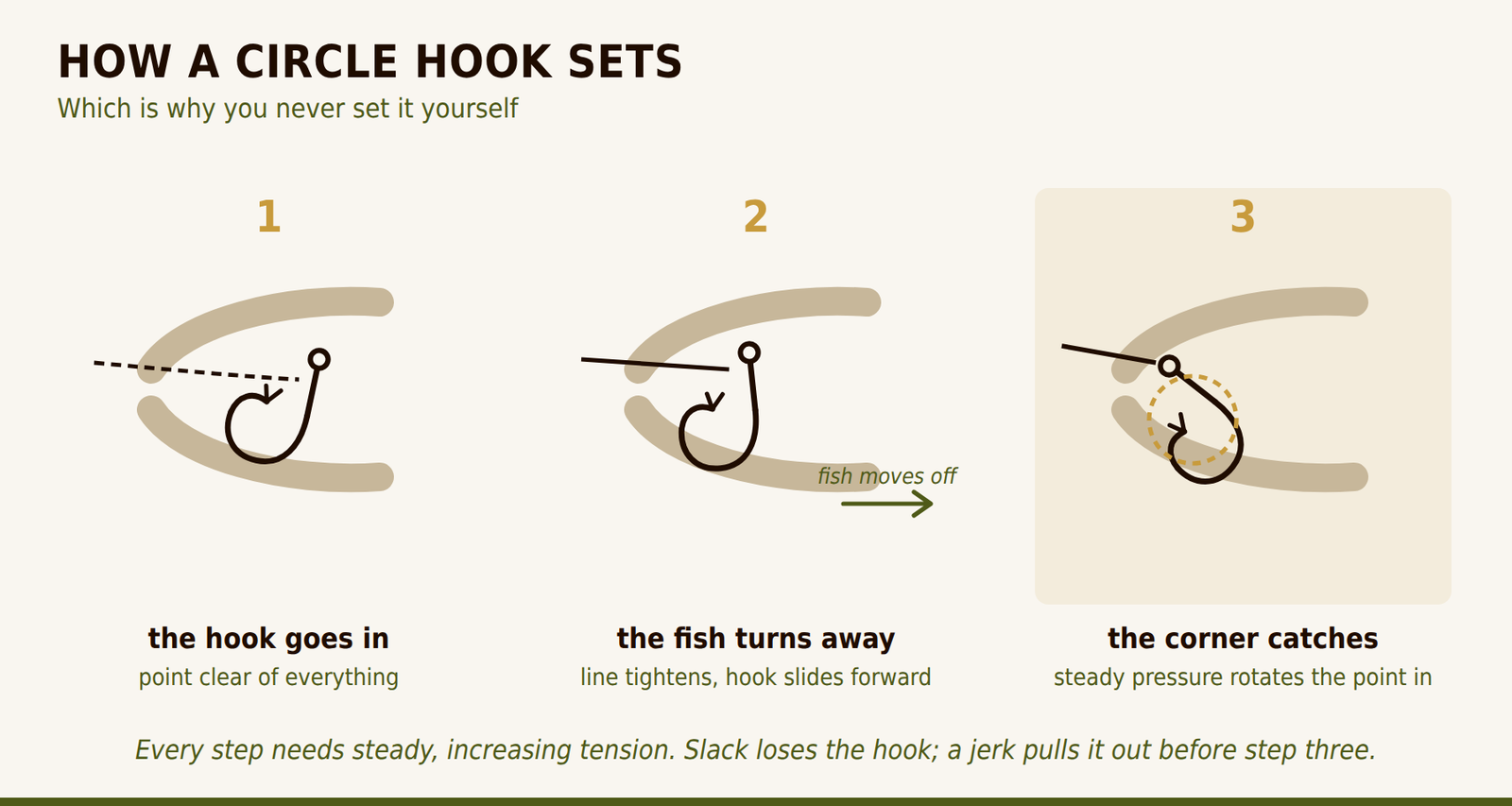
Worth walking through, because understanding it is what stops you setting the hook.
One. The fish takes the bait and the hook goes into the mouth, point still clear of everything. Nothing is hooked yet.
Two. The fish turns away and moves off. Line comes tight against the weight of the rig, and the hook begins to slide back toward the front of the mouth.
Three. As it reaches the jaw, the gap catches on the corner and steady pressure rotates the point into it. The fish has hooked itself in the one place a hook can sit without doing damage.
Every part of that needs steady, increasing tension. Slack lets the hook fall out. A sudden jerk pulls it out before step three happens. What you do is close the bail or engage the reel, let the rod load, and start winding.
This honestly took me a lot of time and a lot of missed fish to understand about circle hooks. I was used to ripping that rod like a tournament bass fisherman. Little did I know at the time, I was ripping that circle hook right out of those catfish mouths.
Sizing: match the bait, not the fish
The most common sizing mistake is choosing a hook for the fish you’re hoping for. A 10/0 hook does not catch bigger catfish; it catches nothing at all when there’s a small bait on it.
| Bait | Hook | Notes |
|---|---|---|
| Nightcrawlers, shrimp, liver | 2/0–4/0 circle | Small baits need small gaps |
| Cut bait chunks | 5/0–6/0 circle | The everyday size |
| Big cut bait, shad heads | 7/0–8/0 circle | Gap has to clear the chunk |
| Live bluegill and sunfish | 5/0–8/0 Kahle | Wide gap through a thick bait |
| Punch and dip bait | Size 6 treble | With a bait holder or sponge |
A 3/0 to 5/0 will land the largest channel cat or blue you’re likely to meet — hook size is about presenting bait, not about strength. Where strength matters, it’s the wire gauge and whether the bend is forged, not the number on the packet.
Mistakes that cost fish
Buying offset circle hooks by accident. Covered at the top, and it’s the most common one.
Setting the hook. Also covered, and the second most common.
Sizing to the fish. A hook too big for the bait means the point never reaches anything.
Fishing a dull hook. Drag the point across a thumbnail. If it skates instead of catching, it’s done. Hooks are the cheapest thing in the box and the only one between you and the fish.
Leaving trebles on a release rig. If you’re putting fish back, a treble is the wrong tool and no amount of care at the boat fixes it.
Frequently Asked Questions
What size hook is best for catfish? 5/0 to 6/0 circle for typical cut bait. Move down to 2/0–4/0 for worms and small baits, up to 7/0–8/0 for big chunks. Size to the bait.
Are circle hooks better than J-hooks for catfish? For hooking fish in the jaw rather than the gut, clearly. Research on other species puts non-offset circles at 5–10% gut-hooking against 35–40% for J-hooks. The trade is that you have to stop setting the hook.
What is the difference between offset and non-offset circle hooks? On a non-offset the point sits in the same plane as the shank; on an offset it’s bent out to one side. The offset version deep-hooks substantially more fish and gives up most of what makes a circle hook worth using.
Do I need Kahle hooks? Only if you fish big live baits. For cut bait a circle hook does the same job with better hook placement.
Can I use treble hooks for catfish? Yes, and for punch bait they’re effectively the only option. Just know you’re trading clean hooking for hold, and check whether they’re legal on the water you fish.
How often should I change hooks? When the point fails the thumbnail test, or after a fish that fought hard. A rusted or opened hook is not worth the re-tie it will eventually cost you.
Where to go from here
Hooks are the cheapest component in the rig and the only one that has to actually hold a fish. Get the type and size right and the rest of the terminal tackle is straightforward.
Once you’ve settled on hooks, the next thing that decides your results is what you tie them into — the complete guide to catfish rigs covers the five presentations they go on, and what catfish actually eat covers what goes on the point.
Don’t give up on circle hooks if you haven’t gotten the hang of them yet. Follow this guide and you will find success. Plus you will be much happier not having to try and dig the hook out of the gut. That’s the worst, especially when you are just having a catch and release session.
That said, if you are using punch bait or most other prepared baits, the treble hook excels here. And if you are using these types of bait, I assume you are going for numbers and plan to plate these fish, so the tradeoff is justified.
Good luck!