What Catfish Actually Eat: Choosing Bait for Channel, Blue and Flathead
This post contains affiliate links. If you buy through them I earn a small commission at no extra cost to you. As an Amazon Associate, I earn from qualifying purchases.
If you’re just starting, the beginner’s guide covers location first, which matters more than bait choice.
A catfish is close to being a swimming tongue.
It carries something in the region of 175,000 taste buds, and they aren’t confined to its mouth. They run down the barbels, which are the densest concentration, and across the fins, the flanks, the tail — the entire outside of the fish. A catfish that swims past your bait has, in a meaningful sense, already tasted it.
That one fact explains most of what follows. Catfish don’t find bait by looking at it. They follow a chemical trail through water that is often too muddy to see a hand in, and they are exquisitely tuned to the amino acids that leak out of dying and decomposing flesh. Every real decision about catfish bait is a decision about that chemical signal: how strong it is, how fast it disperses, and whether it smells like something the species you’re after actually wants to eat.
Which means the most common mistake isn’t choosing the wrong bait. It’s choosing a bait that stopped signalling three hours ago.
Freshness beats everything else
If you take one thing from this post, take this one, because it outranks brand, type and technique combined.
Fresh bait outfishes frozen bait, consistently and by a wide margin. Catfish Edge puts it about as bluntly as it can be put: fresh baits will outfish frozen “almost every day of the week and twice on Sunday.”
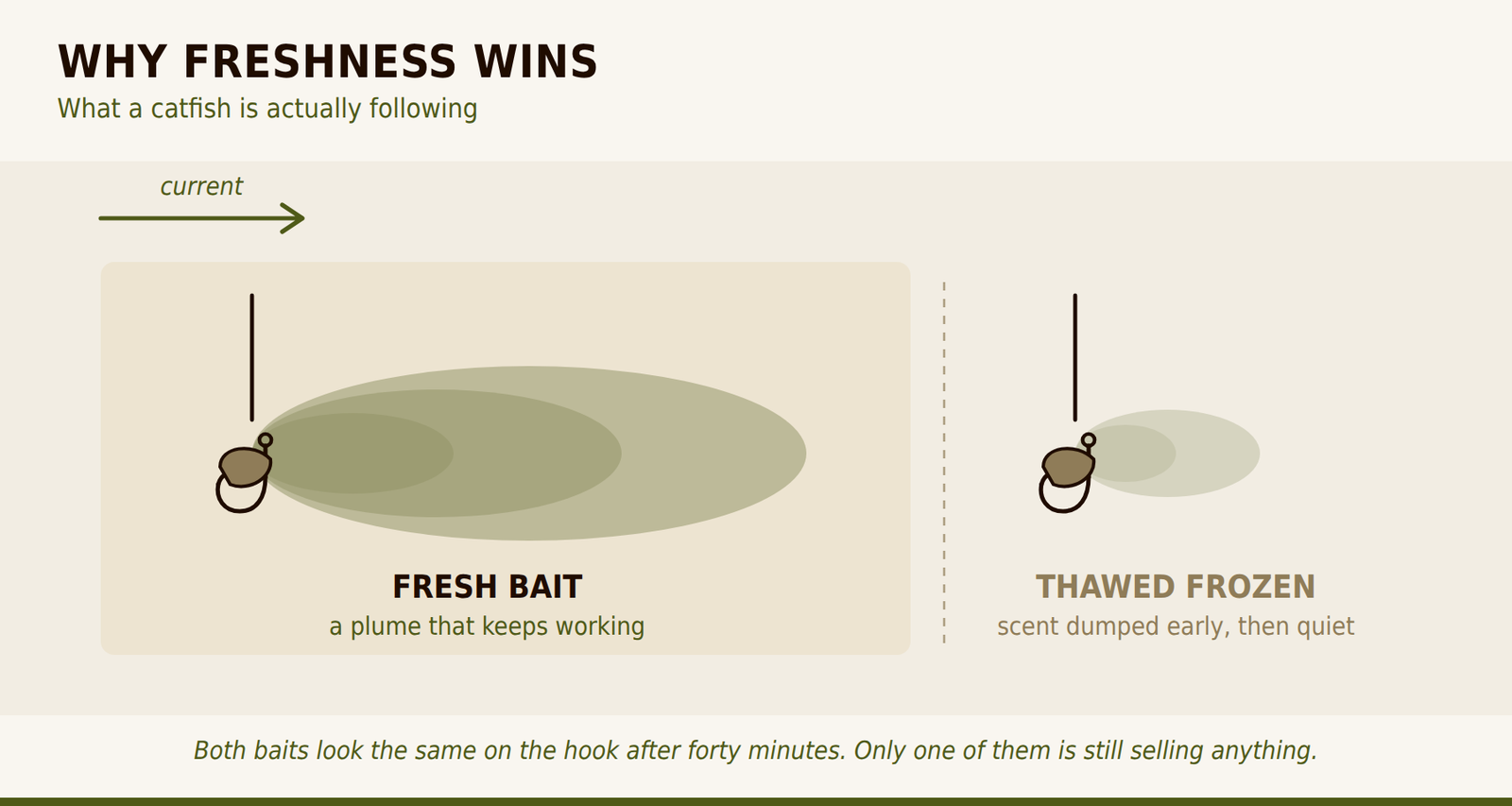
The reason follows directly from the biology. What you’re selling is a chemical plume. Freezing ruptures cell walls, and thawed bait dumps most of its scent load in the first few minutes, then goes quiet. Fresh bait leaks steadily. A frozen chunk that’s been in the water forty minutes is, chemically, a piece of rubber with a hook in it.
Practical version of that rule:
- Catch your bait the same day where it’s legal and practical. This is the single biggest upgrade available to most catfish anglers, and it costs nothing.
- Re-bait on a timer, not on a bite. Twenty to thirty minutes with no interest and it’s time to freshen up regardless of how intact the bait looks. Looking fine and smelling like nothing are not the same thing.
- Keep bait cold and out of the sun. A cooler, not the floor of the boat.
- If you must use frozen, thaw it in a cooler rather than in the sun, and accept that you’ll be changing it more often.
Three species, three different animals
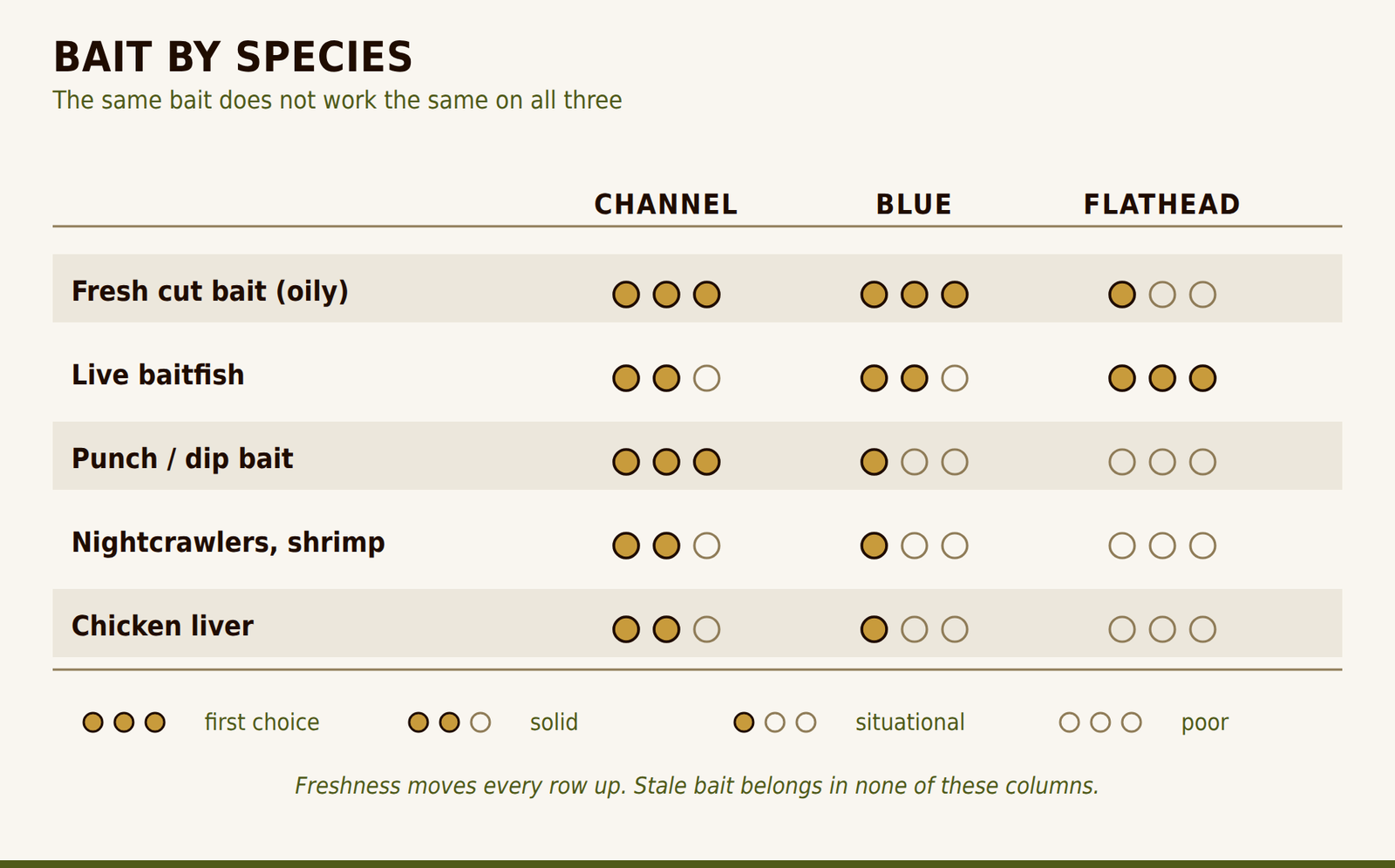
Channel, blue and flathead catfish get lumped together constantly, and it’s the reason a lot of people struggle. They feed differently enough that the same bait presented the same way will do very well for one and get ignored by another.
If you’re not certain which species you’re targeting, start with identification.
| Channel | Blue | Flathead | |
|---|---|---|---|
| Feeding style | Opportunistic omnivore | Predator and scavenger | Ambush predator |
| Best bait | Prepared baits, cut bait, almost anything | Fresh oily cut bait | Live fish |
| Will take dead bait? | Readily | Readily, if fresh | Reluctantly |
| Bait size | Small to moderate | Moderate to large | Large and lively |
Channel catfish
The least fussy fish in fresh water. Channels are scavengers with a broad diet, and they’ll eat prepared baits, cut bait, worms, shrimp, and a long list of things nobody would call food.
For numbers, use prepared baits. Punch baits and dip baits are genuinely deadly on channel cats and there’s no reason to be snobbish about it. They’re built to do exactly what the biology above describes: put a heavy, persistent scent plume into the water.
For bigger channels, switch to fresh dead fish. A fresh cut chunk of shad, perch or bluegill will pick out the larger fish in a population that a punch bait will not. Bigger channels lean predatory in a way small ones don’t.
That’s the real trade with channel cats: prepared bait for a busy evening, fresh cut bait for a better fish.
Blue catfish
Blues are the species where the freshness rule bites hardest. They want fresh, oily cut bait, and the standard is shad — threadfin or gizzard — or skipjack herring where you can get it.
Oil content is the point. Oily fish put out far more scent than lean fish, which is why shad and skipjack dominate this conversation while a fillet of something lean does comparatively little.
Presentation scales with the fish you’re after. Small shad go on whole. Larger shad and skipjack get cut into chunks or strips for average blues, or fished whole when you’re specifically hunting a big one. Fresh cut carp, drum, buffalo, perch and bluegill all work too, where legal — the rule is fresh and oily, not any particular species.
Flathead catfish
Flatheads are the outlier, and it’s worth being direct about it: flatheads want live bait, and mostly won’t take anything else.
They’re ambush predators that hunt live fish, typically at night, usually tight to heavy cover. Live perch, bluegill, sunfish and other hardy baitfish are the standard. The bait needs to be genuinely lively — a sluggish baitfish on a hook is a considerably weaker proposition to a flathead than a strong one fighting the line.
Cut bait can work for flatheads, but mostly in moving water or with a moving presentation, where the current does some of the work of making it seem alive.
Set your expectations accordingly. Flathead fishing is low-volume, high-reward fishing: one or two fish in a day or a night is a good outing, not a poor one. If you’re used to catching channels in numbers, that’s a different sport with a different rhythm.
A word on live bait and the law. Live bait is regulated much more tightly than dead bait, and the rules vary sharply by state and sometimes by individual water. Using game fish such as bluegill as bait, moving live fish between water bodies, and using goldfish or other non-native species are all restricted or outright illegal in many places. Check your state agency’s current regulations before you fill a bait tank — this is one of the easier ways to end up with an expensive citation. What varies by state covers the bait rules in more detail.
The bait categories, briefly
Cut bait. Fresh dead fish, cut into chunks, strips or fished whole. The workhorse for blues and big channels. Oily species outperform lean ones. Cut it fresh, cut it at the water where you can.
Live bait. Essential for flatheads, useful for big blues, and by a distance the most work. You have to catch it, keep it alive, keep it lively, and stay on the right side of a set of rules that changes by state and sometimes by lake.
Prepared baits. Punch baits, dip baits and dough baits, built to hold and release scent. Excellent for channel catfish in numbers. They need the right hook or bait holder to stay on, and they’re messy in a way that’s worth knowing about before you open the tub in a clean boat.
Natural oddments. Nightcrawlers, shrimp, chicken liver, and a long tail of local traditions. These genuinely catch channel cats. They’re rarely the best available choice, but they’re cheap, they keep, and they’ll get a beginner catching fish this weekend — which matters more than optimality.
The part every guide skips
Every bait guide you’ll read, this one included, puts fresh-caught bait at the top. That’s correct and I’m not going to soften it. Fresh beats frozen, and bait you caught an hour ago beats bait somebody else caught last season.
Then every guide stops, as though the cast net were a footnote.
It isn’t. Catching your own shad means a net you know how to throw, somewhere to throw it, a tank to keep them in and the time to do all three before you make a single cast. Catching bluegill for flathead bait means fishing for one species so you can fish for another. Every one of those is a skill, and the people telling you it’s simple learned it so long ago they’ve forgotten it was ever a step.
I don’t do any of it. I fish from the bank on lakes and reservoirs, and for now my bait comes out of a shop, not a net. If that’s you too, none of the above is a reason to stay home — it just means the honest advice is different:
Buy the freshest thing you can and use it fastest. A shop-bought bait that’s been thawed once and fished within the hour beats a better bait that’s been in your cooler since dawn.
Re-bait on a clock, not on a bite. Thirty minutes is the outside limit. Scent output collapses long before bait looks used up, and that’s true of everything you can buy.
Prepared baits are not a compromise for channel cats. For numbers of channels, a good punch bait will out-fish a mediocre chunk of cut bait, and it doesn’t care that you bought it.
Accept that flatheads are mostly off the menu, and be honest with yourself about it. They want live fish. If you’re not catching bait, you’re fishing for channels and blues, and there is nothing wrong with that.
Matching bait to conditions
Bait choice isn’t only about species. Three conditions shift it:
Water temperature. Cold water slows a catfish’s metabolism and its willingness to chase. In cold water, lean toward fresh cut bait fished slowly and patiently, and expect scent to disperse more slowly. Warm water is when prepared baits come into their own.
Current. Moving water spreads a scent plume for you — a considerable advantage. It also strips prepared baits off a hook faster, which pushes you toward cut bait in real flow.
Clarity. In muddy water the chemical signal is doing all the work, so favour whatever smells strongest. In clearer water the visual element starts to matter, which is one of the few situations where a livelier or more visible bait genuinely earns its place.
As for my personal choice, I more often choose chicken livers than anything else. Nothing to do with superiority over the others. Just a matter of convenience and familiarity to me, as that’s what I grew up on catfishing with. I also typically fish a calm lake, primarily targeting smaller to medium size channels for cleaning and eating.
For my once in a awhile river trips, I will opt for a cut bait or live when I can get it. On those trips I’m chasing flatheads and larger channels.
For the prepared baits, I have used them and have even made some homemade baits and they performed well. Nothing at all wrong with those options if you want to start there.
Mistakes that cost fish
Fishing dead bait for flatheads and blaming the spot. Wrong bait for the species, most of the time.
Leaving bait out too long. Covered above and worth repeating, because it’s the most common and the most invisible error on this list.
Buying frozen when fresh is available. Convenience has a real cost here.
Using enormous bait for average fish. Match bait size to the fish you actually expect, not the one on the wall in the bait shop.
Assuming the bait is the problem. Sometimes it is. Often it’s the presentation — a bait buried in soft bottom is invisible no matter how good it is, which is exactly what the Santee Cooper rig exists to fix.
Frequently Asked Questions
What is the best all-around catfish bait? Fresh cut shad. It catches all three species, it’s available in most catfish water, and it’s what you’d pick if you could only have one. For channel cats specifically, a good punch bait will out-catch it on numbers.
Do catfish prefer stinky bait? Partly true and often overstated. Catfish are drawn to strong scent, but they’re drawn to the amino acids in fresh and decomposing flesh, not to rot as such. Genuinely spoiled bait is worse than fresh bait, not better.
Can I use frozen shad? Yes, and plenty of fish get caught on it. It’s simply a step down from fresh, and you’ll need to change it more often.
What bait for flathead catfish? Live fish — bluegill, perch, sunfish — where legal in your state. Dead and cut baits are a distant second and work best in current.
Is chicken liver good catfish bait? For channel cats, yes, and it’s cheap. It’s soft and comes off the hook easily, so it’s worth using a bait holder or wrapping it in mesh.
How long should I leave bait in the water? Twenty to thirty minutes without interest, then refresh. Scent output falls off long before the bait looks used up.
Where to go from here
Get the bait fresh and get it in front of the right species, and you’ve solved most of the problem. The rest is presentation — putting that bait where the fish is, at the depth it’s feeding, without it feeling anything wrong when it picks the bait up. That’s what the complete guide to catfish rigs covers, and it’s the natural next step from here.