The Santee Cooper Rig: What it Does, How to Tie It, and When to Skip It
This post contains affiliate links. If you buy through them I earn a small commission at no extra cost to you. As an Amazon Associate, I earn from qualifying purchases.
The float on a Santee Cooper rig is not a bobber. It doesn’t suspend your bait, it doesn’t signal a bite, and it has nothing to do with the surface. It’s a lift — an inch or two of buoyancy whose only job is to stop your bait disappearing into the bottom.
Getting that straight at the outset explains everything else about the rig: why the float rides on the leader rather than the main line, why its size matters far more than its colour, and why there are days it should stay in the box.
Mechanically, the whole thing is a slip sinker rig with one part added. One peg float, about a dollar, pinned a couple of inches above the hook.
What that buys you is this. A bait lying flat on soft bottom is, from a catfish’s point of view, barely there. Silt swallows it. Weed covers it. The scent trail that’s supposed to be drifting downstream instead seeps into three inches of muck. You sit there confident you’re doing everything right — because you are, except the bait is buried.
Lift it two inches and everything changes.
Where it comes from
The rig is named for the Santee Cooper lakes in South Carolina — Marion and Moultrie — but it was developed by a Georgia angler named KC Nelms, who worked it out over the course of the 1980s and added the final piece in 1988.
What’s worth knowing is why he built it. Nelms wasn’t trying to solve a soft-bottom problem while sitting at anchor. He was drifting, adapting striper techniques being used on Santee at the time, and he was tired of dragging three-way rigs along the bottom and breaking off on structure. The float was his answer to bait that spent the drift plowing through mud and snags instead of riding above them.
That history matters for a practical reason: most people today fish the Santee Cooper rig anchored, and it works beautifully anchored. But it was designed as a drift rig, and if you’ve never fished it that way, you’re using about half of it.
How to tie it
You need everything from a standard slip sinker rig, plus one peg float.
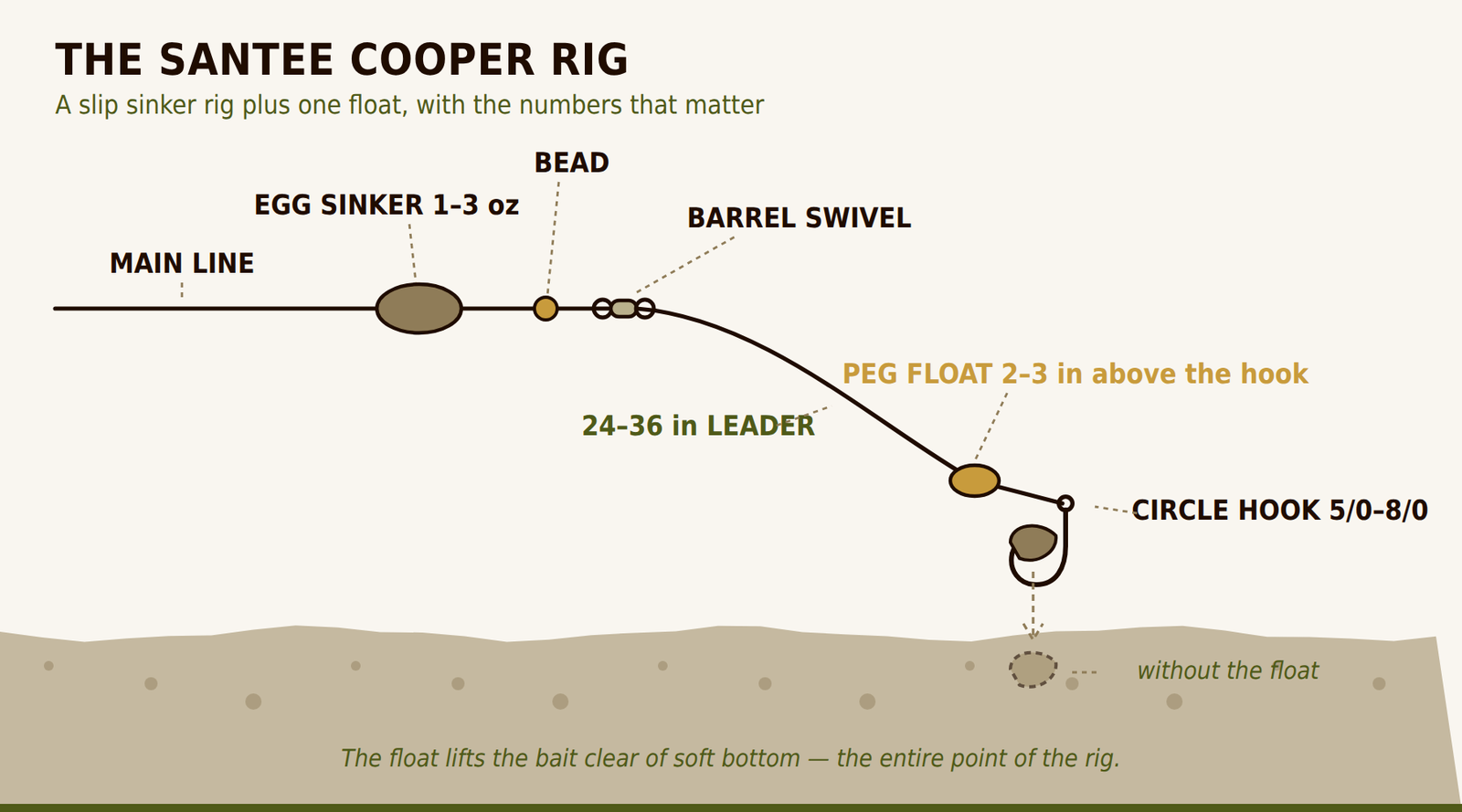
- Thread your main line through an egg sinker, 1–3 oz.
- Slide a plastic bead on behind it.
- Tie the main line to one eye of a barrel swivel.
- Cut a leader 24–36 inches long and tie it to the other eye.
- Slide the peg float onto the leader before you tie the hook on. Forget this and you’re cutting the hook off and starting over.
- Tie your circle hook, 5/0 to 8/0, to the end of the leader.
- Peg the float 2–3 inches above the hook.
Step five is the one everybody gets wrong once. After that, nobody gets it wrong again.
The float is the entire rig
Everything else here is a slip sinker rig you already know how to tie. The float is what you’re actually choosing, and it’s where the rig succeeds or fails.
Size. Peg floats and cigar floats in the 2 to 3 inch range are what most catfish anglers use. That sounds like a narrow range, and it is — but the difference between a 2″ and a 3″ float is significant when you’re trying to lift a heavy chunk of cut bait.
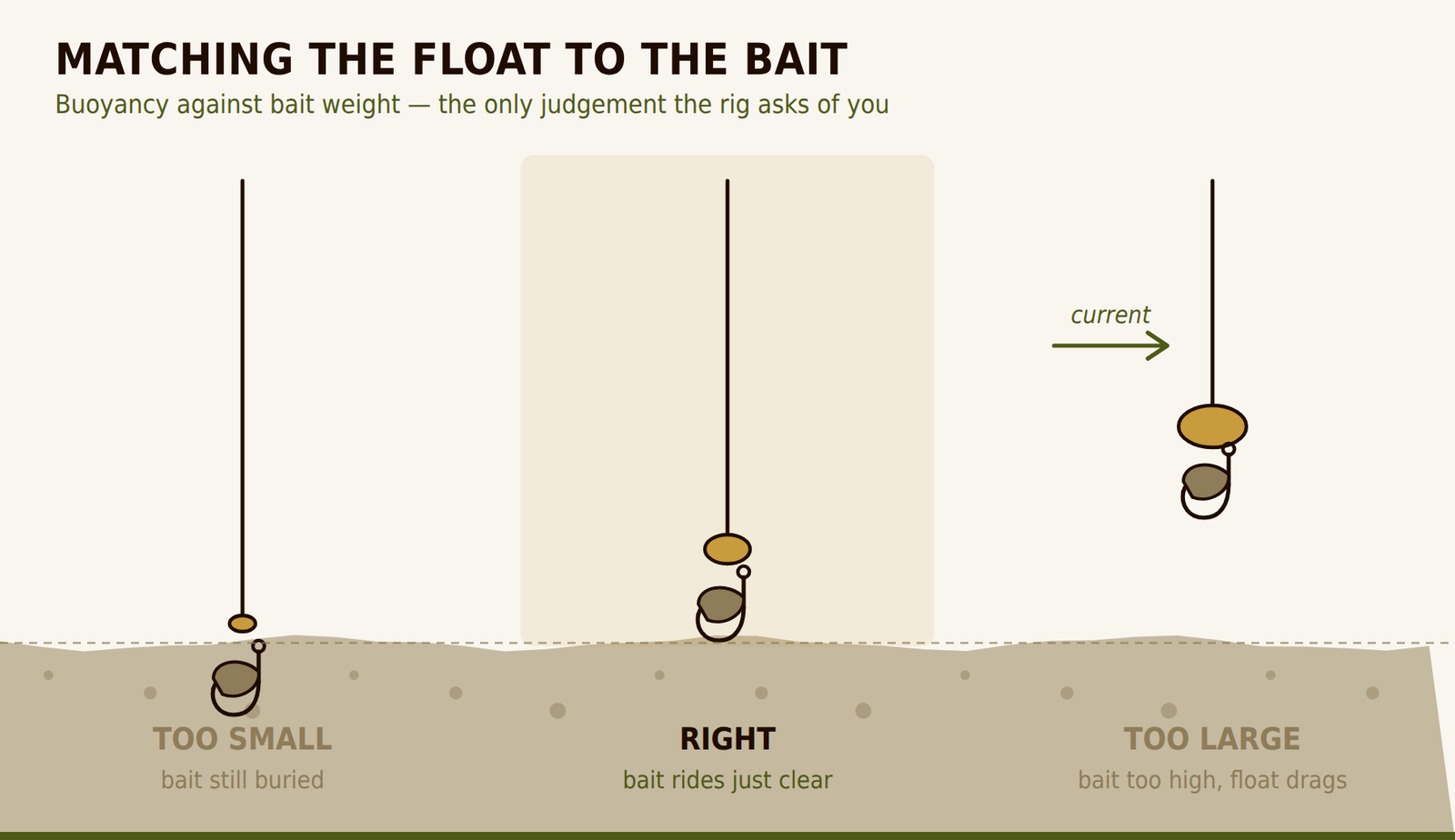
The relationship you’re managing is buoyancy against bait weight. Not fish size, not water depth. How much does your bait weigh, and how much lift does it take to get it off the bottom?
- Float too small — the bait sinks anyway and you’ve achieved nothing. You’ve added a component, felt clever about it, and are still fishing a buried bait. This is the more common failure because it’s invisible; the rig looks correct when you cast it.
- Float too large — the bait rides higher than you wanted, and in current the float becomes a sail. It drags, it swings your bait downstream out of the zone you picked, and it can lift the bait to a level where fish aren’t looking.
A nightcrawler needs almost nothing. A gizzard shad head needs real float. Match the float to what’s on the hook, and carry more than one size — the correct float changes when your bait changes, which is to say several times an evening.
What goes on that hook is its own decision — what catfish actually eat works through it by species, and the bait you settle on is what determines the float you need.
Placement: 2 to 3 inches above the hook. Closer than that and the float crowds the bait and interferes with how it moves. Much further and you lose the direct relationship — the bait can still settle into the mud below a float that’s riding happily two feet above it.
Leader length is what sets the depth
The float lifts the bait. The leader length determines where in the water column that lift happens.
- 24–36 inches is the standard working range and it’s where you should start.
- Shorter keeps the bait tight to the bottom and reduces how much the rig moves in current.
- Considerably longer — and this is the part people underuse — lets you reach fish that aren’t on the bottom at all. Catfish suspend. If your electronics are showing fish holding eight or ten feet up, a long leader with enough float will put a bait in front of them while your weight stays anchored below.
That last case turns the Santee Cooper rig into something quite different from a soft-bottom fix. It becomes a way to fish a specific depth without a slip float and without a boat sitting directly over the fish.
Weight
1 to 3 ounces covers most lake and reservoir fishing. Two is a reasonable default. In still water you can sometimes get away with a single ounce.
In current, use the least weight that holds your bait where you put it — and remember that the float is working against you here. A float that adds lift also adds drag, so a Santee Cooper rig generally needs a little more weight in flow than a bare slip sinker rig would.
If you’re drifting, weight is doing a different job: it’s controlling how the rig tracks along the bottom, and a no-roll or a slinky-style weight will hang up far less than an egg sinker will.
Anchored versus drifting
Anchored is how most people fish it, and it’s the right approach when you’ve found a spot — a hole, a channel edge, a laydown — and you want a bait sitting in it. The float keeps the bait visible and mobile while you wait.
Drifting is what the rig was built for. You cover water, the weight tracks the bottom, and the float keeps your bait riding just above it instead of plowing through it. On a big flat where fish are scattered, this finds them far faster than waiting will.
The setup changes a little between the two. Drifting favors a slightly longer leader, a float on the larger end, and a weight shaped to slide over structure rather than dig into it.
Personally, I have fished this mostly anchored. I have been on a few guided trips and those guides used this rig for drifting and it worked very well.
When to skip it
Most rig guides won’t tell you this, so: the Santee Cooper rig is not a strict upgrade over a plain slip sinker rig. It’s a specialized tool, and there are conditions where the plain version is better.
Hard, clean bottom. Gravel, rock, packed sand, riprap. If nothing is going to bury your bait, the float is adding drag and complication for no benefit.
Heavy current. The float catches flow. In fast water it will lift and swing your bait out of the seam you were trying to fish, and you’ll compensate with more weight — which is more resistance for a fish to feel.
Very light baits in clear shallow water. A small bait suspended under a bright float in three feet of clear water is not a natural presentation.
Anywhere it’s collecting debris. In water carrying leaves or filamentous weed, the float is one more thing for junk to gather on, and a fouled float stops floating.
The rule is the same as with any rig: it isn’t a setting, it’s a variable. If the bottom is soft, use it. If it isn’t, don’t reach for it out of habit.
Mistakes that cost fish
Tying the hook before sliding the float on. The universal one. Build the rig in order.
One float size in the tackle box. The float has to match the bait, and the bait changes.
Pegging it too far up the leader. Two to three inches. It’s holding the bait up, not decorating the leader.
Using it as a default. See the section above. Soft bottom is the reason this rig exists.
Setting the hook. Same as any circle hook rig — tighten down and reel, don’t swing. If that’s costing you fish, it may be your rod rather than your technique; the guide to choosing a catfish rod covers why a stiff tip works against circle hooks.
Frequently Asked Questions
What size float for the Santee Cooper rig? A 2 to 3 inch peg or cigar float covers most catfishing. Size up for heavy cut bait, down for small baits. Carry both.
How far above the hook does the float go? Two to three inches. Close enough to lift the bait directly, far enough not to crowd it.
Can I fish the Santee Cooper rig from the bank? Yes. Anchored bank fishing over soft bottom is exactly the situation it handles well. You lose the drifting application without a boat, but the core benefit is unchanged.
Is it better than a slip sinker rig? Over soft bottom, yes, clearly. Over hard clean bottom, no. They’re the same rig with one part, and that part solves one specific problem.
Does the float spook fish? Not in the stained or muddy water where you’d normally use this rig. In very clear shallow water it’s a fair concern, and a more subdued float colour is a reasonable adjustment.
What weight should I use? One to three ounces in lakes and reservoirs. In current, the lightest weight that holds position — and expect to need slightly more than you would without the float.
Where to go from here
The Santee Cooper rig is the second rig worth learning, right after the one it’s built on. If the slip sinker rig isn’t yet automatic for you, start there — it’s the foundation for this and three others, and it’s covered in the complete guide to catfish rigs.
Once both are second nature, the only real skill left is reading the bottom well enough to know which one the water in front of you is asking for.